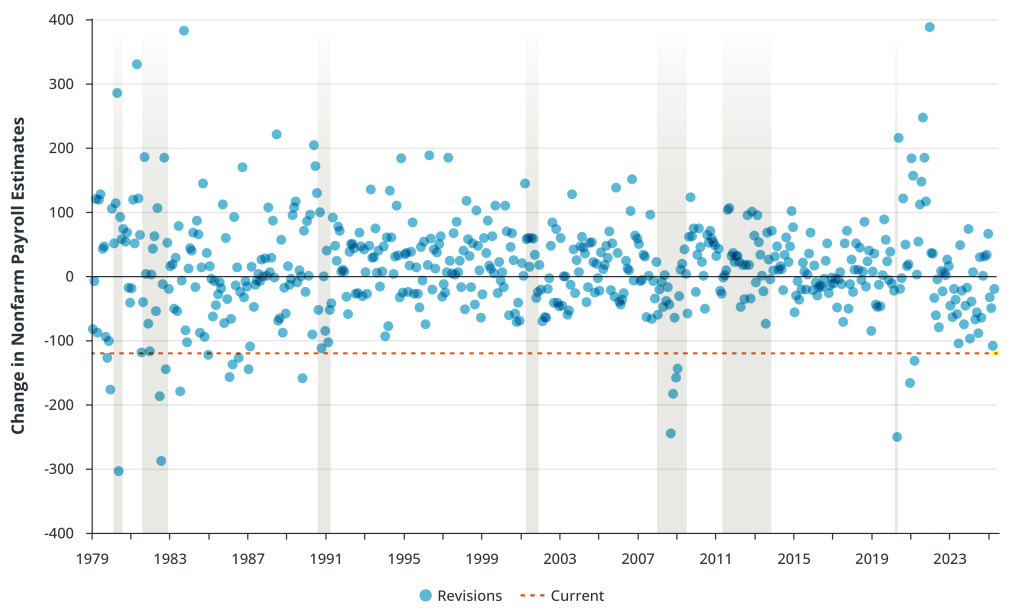
Historically, most revisions have been under 100,000 discounting those during recessions or extraordinary economic times. These revisions provide incontrovertible proof of the ongoing labor market freeze which has led to a dearth of new opportunities despite fewer layoffs.
Weekly Economic Outlook
08/07/2025
The Truth About Data Revisions
Most labor market data can do one of two things well: be highly accurate or be very timely. Very few can do both, and, unfortunately, nonfarm payroll estimates from the Bureau of Labor Statistics (BLS) are not among them. Nonfarm payroll estimates can be highly accurate, but they usually take up to three months from the initial point of estimation to get right. This is due to the methodology of the Current Establishments Survey (CES), which is the principle source of data on employment from the perspective of U.S. businesses.
The CES relies on responses from a sample of U.S. businesses. For each month, BLS incorporates responses from three separate samples of U.S. businesses in three separate timeframes. For example, if it were attempting to estimate employment in April, BLS would ask one group of businesses about the number of people they employed in April. Then, in May, it would ask another group of businesses about the number of people employed the month prior. Then, in June, it would ask another group of businesses about the number of people employed in April. Finally, these responses undergo additional adjustments as BLS corroborates the responses with data from state unemployment offices and other government agencies.
Despite these rigorous methods, revisions can still be substantial and, unfortunately, revisions for both May and June proved to be so. According to the latest datapoints, revisions to initial estimates show the labor market created 258,000 fewer jobs, or in actuality, only produced 33,000 jobs. Historically, most revisions have been under 100,000 discounting those during recessions or extraordinary economic times such as the Great Resignation. These revisions provide incontrovertible proof of the ongoing labor market freeze which has led to a dearth of new opportunities despite fewer layoffs. Relief through interest rates or lower inflation will likely not reach the labor market until late 2025 or 2026, which means that staffing firms will have to remain flexible and innovative to clinch new orders in a low-churn environment.
Revisions to Nonfarm Payroll Estimates
Weekly Staffing Research Outlook
08/07/2025
In this period of low turnover, staffing firms must craft a compelling value proposition, helping talent understand that not all side hustles are equal, and many can even be a relative waste of a worker’s time and effort.
Growing Majority of Workers Want Opportunities to Supplement Income
The meager July jobs report released last week paints an alarming picture. However, it also reinforces the widespread sentiment of workers who believe the economy is under distress. In this case, it is the data that was out of step with sentiment instead of the other way around. Most respondents to the most recent ASA Workforce Monitor® survey (fielded April 21-23) believe a recession will occur within the next year (47%) or is already here (21%).
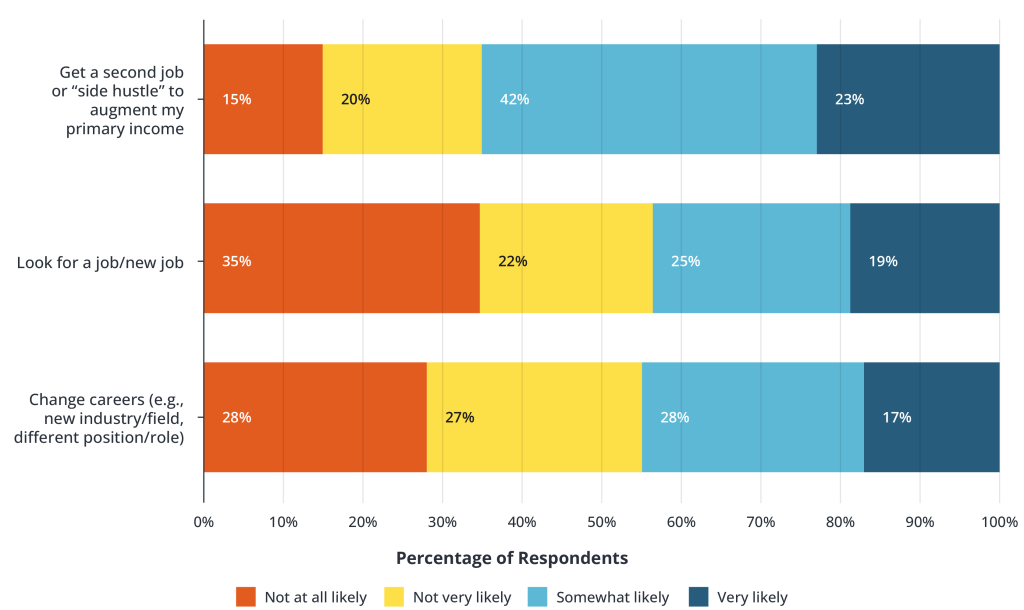
Workers, like businesses, want to mitigate risk during precarious times and modify their behavior on the labor market accordingly. Many are seeing how difficult it is in the job market and are choosing to stay put, depressing labor turnover. While churn is low, there is a growing proportion of workers who desire to minimize risk in another way: to supplement their incomes via a second job or side hustle. More than six in 10 (64%) of U.S. workers say they plan to get one of the two within the next 12 months, up eight points from the last time the same question was asked in 2024.
In this period of low turnover, staffing firms must craft a compelling value proposition, helping talent understand that while side hustles can help supplement income, not all side hustles are equal, and many can even be a relative waste of a worker’s time and effort. Staffing agencies should highlight their ability to introduce candidates to high-quality opportunities; those offering guaranteed pay and flexibility as well as potential career opportunities, things that can position working with your company as a smarter alternative to gig work apps or DIY side hustles.
Propensity for Different Career Changes