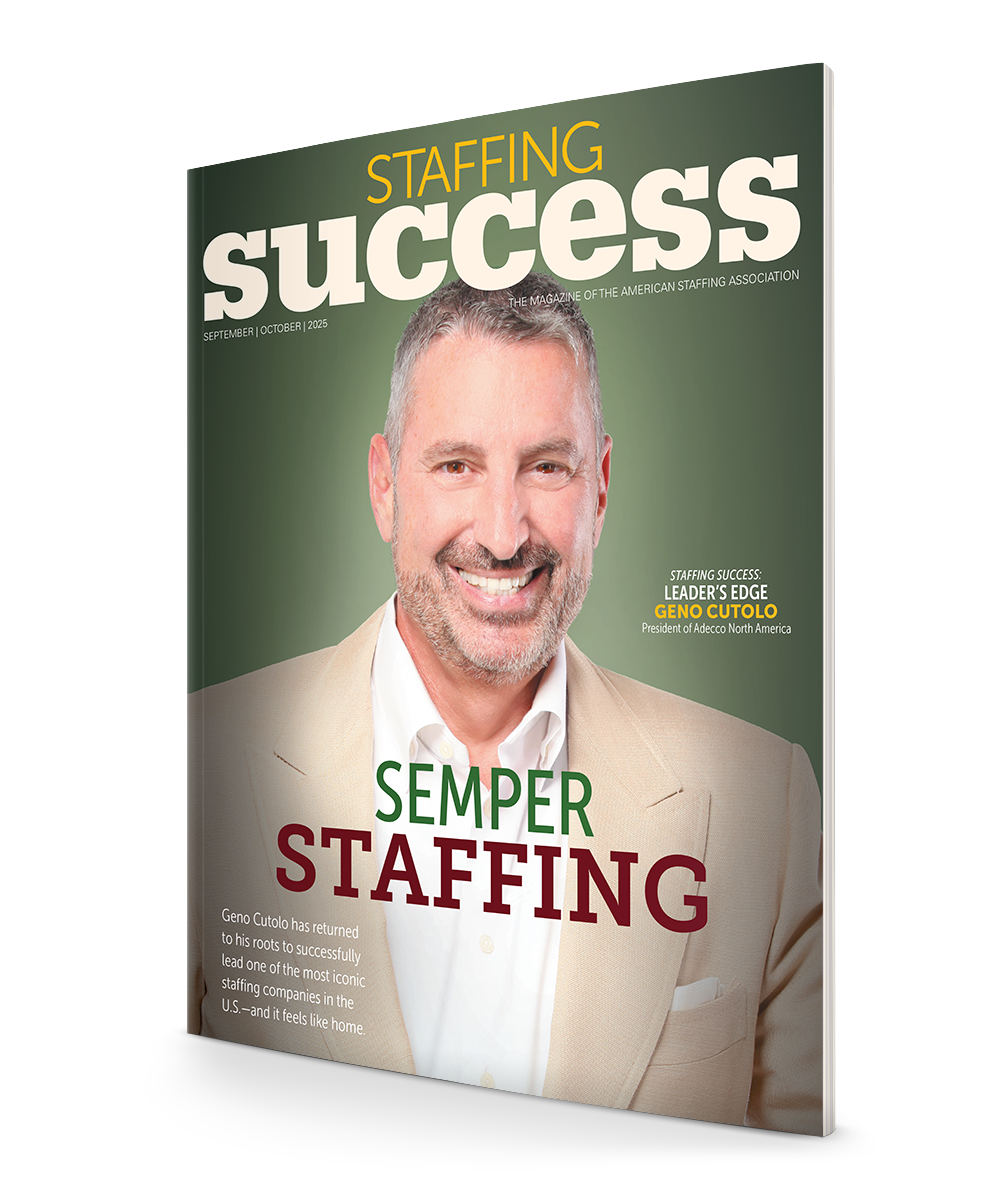
As an aspiring veterinarian at Rutgers University, Geno Cutolo tried his hand at sales—at the recommendation of a trusted professor. He tried it and was clearly a natural, and soon he would enter the staffing world. More than 25 years later, he has never wavered from the industry he loves.
Semper, the Latin word for “always,” is often heard in the context of U.S. service members and the mottos that guide their missions: Semper Fidelis (“always faithful”) for the Marines; Semper Paratus (“always ready”) for the Coast Guard. Whether a fresh-faced recruit or an experienced officer, service members remain focused on the mission, stay the course, and work faithfully with the men and women in their company. As does Cutolo, president of Adecco North America since November 2022, whose career, leadership, and passion for the staffing industry has resulted in the kind of success that attracts the attention of business analysts, investors, and clients alike.
What fuels Cutolo and the double-digit growth Adecco North America experiences even in a down economy? The answer is multipronged and even somewhat complicated but always grounded in staying the course and remaining faithful to the mission—allowing him to be proactive instead of reactive to the changing conditions around him.
Proud father of a U.S. Marine (and four more children he’s raising alongside his wife Amanda), Cutolo shares his staffing story and offers insights and valuable takeaways for anyone invested in the success of the staffing industry and the future of work.
ONE (REALLY) GOOD RECRUITER
Cutolo caught the staffing bug by way of his natural sales savvy—that ease in connecting with people and their stories (the same qualities his immunology professor had seen so many years ago and the same caring outlook that inspired his love for animals and interest in veterinary school).
In his first year in B2B sales—selling mailing and shipping solutions to firms in New York City—Cutolo became the top salesperson at his company. He recalls all the cold calls, knocking on every door in a skyscraper full of offices, taking the subway uptown to walk through another building full of offices, and call after call after call. Until one day Cutolo got a call—from a recruiter. The recruiter explained he had a really good opportunity for him in a national sales role with a company called Adecco. He took the job and quickly learned the ins and outs of the services he would be selling.
“And that was it. I was hooked on staffing,” he recalls. That recruiter made the ultimate life-changing match and launched a career that has been as rewarding as it is successful. “That match that he made, it’s still with me to this day—more than 25 years later. That’s what we do in this business—we make matches. If we can do that good of a job every time we make a match, then we can literally change the world.”
That’s not hyperbole. Cutolo means it. He believes it, and so do his Adecco peers, he says—which tees up Cutolo takeaway No. 1: Succeeding in staffing means truly believing in the business and its mission of providing people with job opportunities.
When you put people first—candidates, clients, peers, partners—success can happen.
But neither is the staffing business for the faint of heart. The constant change and the fast pace also inspired Cutolo. It’s exciting. It’s challenging. (And that’s where events, webinars, legal guidance, and other resources from ASA come into play.)
“At the end of the day, when you think about what we do (connect people with work), that’s a really special thing,” Cutolo says. “Right from the very start, I felt like it was a sacred responsibility. Because what we do is enable. Through the power of a job, we enable them to feed themselves and their loved ones, to clothe themselves and their loved ones, to have shelter. And these are the most basic of human necessities that every human being on this planet has the need for.” There are so many stories, he adds, of individuals whose lives were ultimately changed because of a job and where that job may have led them. “That’s my ‘why,’” he says.
And even as technology continues to evolve, including (and especially) artificial intelligence, that “why” remains—through ups and downs, expansions and contractions, and recessions and recoveries. But what happens when you’re a multinational publicly traded staffing company that has to respond to shareholders? When all eyes are on you as a leader in the space? How do you balance public scrutiny and internal game plans that rely on employee buy-in?
No one would deny that staffing is a fast-paced and often chaotic business. What separates those companies that rise to the top in tenuous times? “Yes, it can be chaotic,” says Cutolo, and admits that the chaos is part of what he loves about the business. However, as a leader, “I’ve always wanted to bring a kind of calming influence,” he explains. “I think our industry can be very reactive—especially when you’re a public company. Public results come out, you react to those results. But it has always been important for me that we have a long-term vision.”
“I always say keep your eyes on the horizon. You have to execute. You have to do things every day, but you always keep your eyes on the horizon. Bringing that calm into a world of chaos tends to really help with success in a fast-paced industry.”
Cutolo takeaway No. 2: Resist the inclination to be reactive in your business decisions. Instead, be prepared because you know you’ve done a good job of looking ahead.
Exactly how do Cutolo and his Adecco team prepare and look ahead? The key performance indicators (KPIs), tools, and strategies might fill a book, but certain anchors or pillars that he and other company leaders abide by support a strong culture of readiness, vision, and collaboration.
DON’T SINK, (PREPARE AND) THINK
Cutolo tells the story of a Navy Seal training video he saw years ago that made a lasting impression on him: Two trainees are chained, each to a metal chair, and subsequently dropped into a deep pool of water. One of those trainees went into a panic, Cutolo recalls, and essentially “drowned” as part of the scenario (trainers dove in to rescue him). The other Navy Seal landed with a thud at the bottom of the pool and began to calmly look around. “He spent maybe 20 or 30 seconds doing that and then calmy began to extricate himself,” Cutolo explains. “He was able to free himself from the chains and swim to the surface.”
“That was a lesson that stuck with me,” he adds. “Not only was it not reacting, but it was also staying calm—and staying calm in a crisis…There’s a lot of pressure in our industry. There’s pressure to fill orders. There’s pressure to win customers, to keep customers, and outperform the competition. It can be a very high-pressure industry.”
And sometimes even the very best preparation may seem like it isn’t enough, but it’s by far much better than the sinking alternative. Cutolo says Adecco North America uses industry data and economic analysis from ASA “constantly” as part of its preparation and ability to remain agile. “It’s data all the time,” he says. Adecco leaders also tap into various news sources, including Staffing Today, and participate in events, such as Staffing World® and networking opportunities.
When it comes to KPIs, Cutolo and his team stay close to fill rate and retention. Those two simple but critical data points can uncover a lot, he explains. Fill rate not only measures the number of people placed but also requires a strategic mindset for client needs and job-seeker readiness. Retention rate, which tracks assignment completion or whether an individual stayed at a job, can also speak to all the processes behind that placement. Is it working? Why or why not? Where are we successful? How do we apply that success to other areas?
Cutolo says he and his team use a data dashboard they informally call a Christmas tree because of all the points of data entry and analysis. “Over the past couple of years, we’ve improved our fill rate by a significant amount,” he says. “And today, we’re putting more people to work than a year ago—and that number keeps climbing.”
Being calm amid change. Being prepared to perform better. And cultivating a people-focused culture in a people-focused industry. These are all critical to Cutolo’s success as the president of Adecco North America.
But wait, there’s more.
FOLLOW THE RED THREAD (AGAIN)
Cutolo is one of five children raised by Italian parents on Staten Island, NY, where his staffing career with Adecco began (by way of Rutgers University in New Jersey) more than two decades ago. His career and love for staffing and sales have grown and evolved by way of opportunities and leadership roles at other standout staffing firms, including Staffmark and ProStaff. He learned as much as he could along the way, working out of Atlanta for a stint, then moving to North Carolina to open up new markets, and then finally settling in South Carolina—just outside Greenville—where his wife has roots and family. Cutolo is no doubt a New Yorker, but has become a South Carolinian at heart and appreciates the environment for his kids—two girls and three boys. The oldest is 26 (a U.S. Marine) and the youngest is 10.
But it was nearly three years ago when Cutolo’s staffing career finally came full circle—thanks to a single thread of continuity, or what he says is the Adecco “red thread.” “We have a really special culture—one that has staying power over many, many years,” he says. “It’s unbelievable the amount of people who leave Adecco and then come back—myself included.”
In late 2022, Cutolo rejoined his original staffing company as president of Adecco North America. He felt like he was home again, but he didn’t assume he knew all the answers when he stepped into his new role—which brings up takeaway No. 3: Be the least informed person in the room on any subject. Listen deliberately and intently. It will accomplish a lot more if you pull ideas out of other people instead of assuming you have the answers.
The first thing he did upon returning to Adecco was go on a three-month listening tour, Cutolo explains. “I traveled around, all over the country. I visited our branches, our customers, HR, and met with Adecco colleagues across the world. I made a point of really listening—listening to our people, listening to our customers. And it wasn’t until I completed that that we started to formulate a plan.”
Adecco and the industry overall was still recovering from the pandemic. Cutolo says there was change fatigue and abundant unpredictability, which can weigh heavily in an environment where growth is the goal. In his new role, Cutolo was charged with a turnaround. “It was exciting to be part of that story—especially with a company that has such a strong legacy like Adecco.”
A very important follow-up takeaway (No. 4): Act on what you heard and patiently and persistently follow up on that action. “How do people know if you’re listening?” Cutolo asks. “You act. Act on what you heard. You have to listen, and you have to follow up.”
With a strong leadership team in place and a long-term vision built around three strategic objectives (informed by the three-month listening tour), the past nearly three years under Cutolo’s new leadership have proven successful. Adecco’s North American revenues were 10% higher in the second quarter of 2025, year-over-year. Performance was driven by exceptional growth in consumer goods and the food and beverage sector, as well as manufacturing.
“We have a good strategy,” he says. “Those three objectives have been the same for the last two-plus years. We fine-tune underneath each one and we may have added or pulled back on initiatives,” he adds, but those core objectives ensure that Adecco North America stays the course, so there’s no need to be reactive but, rather, the company is prepared and agile.
Cutolo thinks back to pandemic times and how the staffing industry was hit by shut-downs and economic headwinds—but there was light at the end of the tunnel, he says. But then there was the next thing, and the thing after that. “You have election uncertainty. You have tariffs. You have geopolitical uncertainty. We’ve gone from one thing to another to another and we’ve been faced with some pretty significant challenges in the last couple of years, when you think about it.”
As Cutolo gets animated in his explanations, his New York enthusiasm for making a point and his Italian-inspired hands punctuate his words. “How do you navigate a storm?” he asks. “If you’re on stormy seas, if your boat gets turned sideways and you get broad-sided by the waves, you’re capsized. You sink, right? You have to steer straight into the waves. You have to have a very steady hand on the tiller, so to speak—steady and strong. And you have to stay the course. You also have to know where you’re going.”
This is how the best-led companies not only survive but consistently come out on top. “We try not to react. We do things purposefully. And we keep our North Star,” Cutolo says.
(KEEP) COLLABORATING AND ASK FOR ADVICE
There is an old adage often used to describe the lives and professional experiences of business leaders: “It’s lonely at the top”—a succinct way of saying it can be an isolating experience to be in charge, when it seems your peers are few and the words of sound advice are even fewer. But when leaders cease to collaborate, they cease to grow, Cutolo explains.
“If you ask me what makes me successful in this industry—and I don’t want to sound too general—but it’s collaboration, and really working across companies, knowing other people, listening and learning from others. I know sometimes we hold things close to the vest; maybe you don’t want to collaborate with peers. But that’s been one of my secret weapons, I would say—always collaborating with peers in other companies.”
Enter takeaway No. 5: Keep a collaborative spirit—even with your competitors. Ask for peer perspectives and seek out advice from mentors.
“I’ve always had mentors throughout my career,” Cutolo shares. He says to simply ask: “Do you mind giving me advice from time to time?” “I’ve had some really good mentors over the years. If I’m struggling with something or have a really big challenge, I’ll brainstorm with other people.”
“What can you do to be successful in this industry? I would say collaborate with others and identify mentors,” explains Cutolo. Among his standout mentors throughout his career is David Bartholomew, former Staffmark chief executive officer—someone well-known for his business savvy and industry contributions. (Bartholomew served as chair of the ASA board of directors in 2006 and was inducted into the ASA Leadership Hall of Fame in 2019.) ASA also offers peer groups and c-suite-specific programming and events that can help jumpstart or fuel the kind of collaboration Cutolo finds valuable.
Looking ahead, what kinds of challenges might inspire a call or a brainstorming session in the future? Cutolo points to the dominant topic of artificial intelligence and how it is expected to save time—especially at the recruiter’s desk. However, the more important question is “What are we going to do with that time?” Cutolo says that time should be reinvested back into what staffing companies do best—building relationships with people.
“That’s the future of our industry—getting back to that human-centered work,” Cutolo says with enthusiasm. “That’s what makes us a really special industry.” Will the rise of AI and technology lead to change for the industry? “Yes. It will change, just as it has changed with every major industrial or technological advancement in the country. It’s always resulted in change, but it’s also followed by tremendous growth, as well. That is what I believe is our future, and I think it’s a unique opportunity for Adecco.”
is senior director of publishing and marketing for ASA. Send feedback on this article or make recommendations for future Leader’s Edge interviews by emailing s******@americanstaffing.net. Engage with ASA on social media—go to americanstaffing.net/social.