In today’s industrial workforce, qualifications come in many forms. While traditional education still has its place, it no longer tells the whole story. Many great workers don’t have a degree, but they bring what matters most: hands-on experience, a strong work ethic, and the drive to show up and get the job done.
More importantly, the talent pool now includes individuals who are re-entering the workforce after incarceration. These candidates often possess a powerful motivation to turn their lives around; they just need a chance. According to the Second Chance Business Coalition, nearly 85% of human resource professionals say workers with criminal records perform the same as or better than other employees. In fact, second-chance hires tend to outperform traditional hires on both performance and retention.
At the end of the day, it’s about potential—not perfection. When an employer focuses on skill, attitude, and a willingness to work, they uncover talent that can make a meaningful impact on the job site. With more than 77 million Americans having a criminal record, the untapped potential is too large to ignore.
Navigating Background Checks and Legal Considerations
In the industrial staffing sector, background checks have evolved from a routine formality into a cornerstone of client compliance, safety, and risk management. As clients demand more stringent screening, staffing firms face the dual challenge of meeting these expectations while adhering to complex legal standards and upholding fair hiring practices.
One significant issue is overgeneralization—the tendency of employers to apply blanket exclusions based on any criminal history. Candidates with outdated or nonviolent convictions, such as old tax offenses or missed child support, are often disqualified without assessing relevance. This not only limits access to qualified talent but undermines efforts toward equitable hiring—especially critical during a labor shortage. Educating clients on the difference between violent and nonviolent offenses, or between recent and historical convictions, can preserve access to strong candidates while maintaining safety standards.
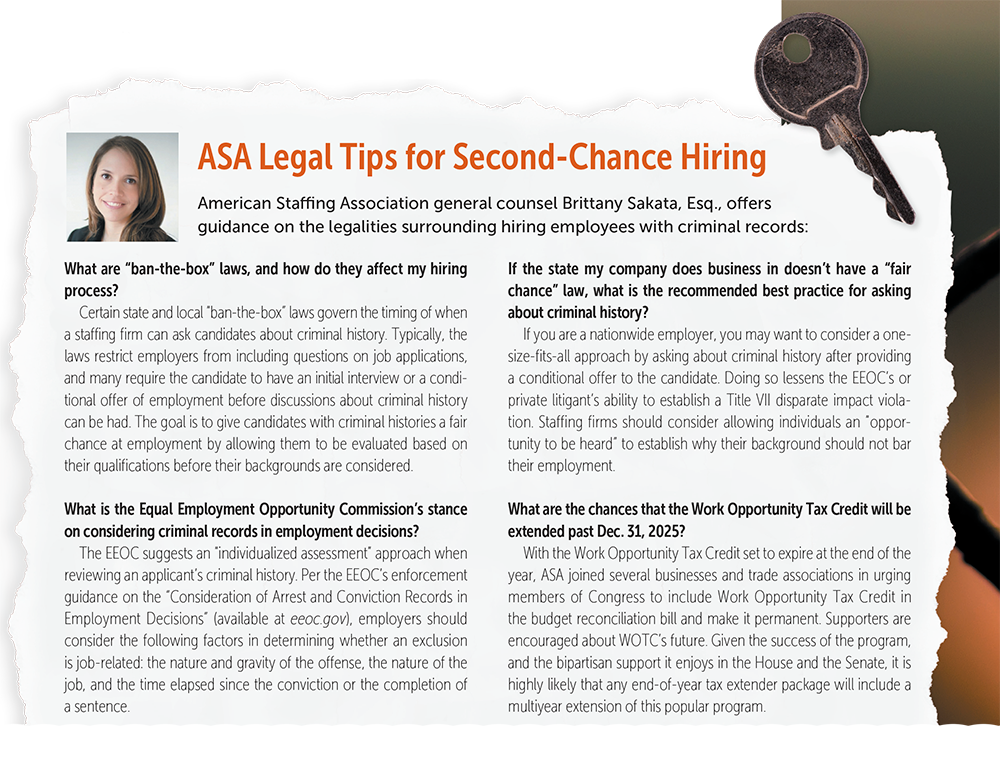
Legal complexity adds another layer. Background check “lookback” periods differ by state; California and New York generally restrict review to the past seven years, while states like Texas and Florida impose no such limits. On top of that, more than 35 states and 150 municipalities have enacted “ban-the-box” laws, which regulate when and how criminal history can be considered—often delaying such inquiries until after a conditional job offer. Violating these laws can result in penalties, lawsuits, and damage to brand reputation.
At the end of the day, it’s about potential—not perfection. When an employer focuses on skill, attitude, and a willingness to work, they uncover talent that can make a meaningful impact on the job site.
To meet this challenge, staffing firms must develop adaptive, legally sound screening protocols. This includes
- Partnering with background check providers who offer state-specific legal guidance
- Training recruiters and educating clients on the nuances of lookback laws, ban-the-box regulations, and offense categories
- Balancing compliance with the need for inclusive, opportunity-driven hiring strategies
Business Incentives for Hiring Second-Chance Employees
Second-chance hiring isn’t just a socially responsible approach—it’s also a business-smart one. Employers who hire individuals with certain criminal backgrounds may qualify for the Work Opportunity Tax Credit, which offers tax incentives of up to $2,400 per eligible employee. In some cases, the credit can reach $9,600, depending on the target group. The WOTC program is set to expire on Dec. 31, 2025, but has been extended multiples times in the past, offering potential long-term benefits to participating businesses.
Staffing firms that embrace this approach can significantly expand their labor pool—an especially valuable strategy amid ongoing labor shortages. Tapping into this overlooked workforce can improve fill rates, decrease time-to-hire, and boost retention—core key performance indicators (KPIs) for both staffing firms and clients.
Take Kelly Services’ “Kelly 33” second chances program as a case study. Launched with Toyota Motor Manufacturing in Georgetown, KY, the program expanded the candidate pool by 20% and reduced turnover by 70%. Kelly also reports a 25% higher fill rate and 2.7% lower turnover for secondchance candidates compared to traditional hires.
These aren’t just feel-good results; they’re real performance metrics. Second-chance hiring strengthens business outcomes while supporting inclusive employment.
Addressing Client Hesitation and Influencing Hiring Decisions
Client reluctance to hire second-chance candidates typically stems from liability concerns or assumptions about candidate quality. But recruiters can change the narrative by presenting labor market data, performance metrics, and success stories. A growing number of skilled workers may lack traditional credentials but have relevant on-the-job experience and interpersonal strengths.
Recruiters should champion competency-based hiring—an approach that evaluates practical ability and potential rather than just formal qualifications. This not only diversifies the talent pool but accelerates the hiring process. As reported in Recruitics’ “The State of Fair Chance Hiring in 2024” article, more than 1.4 million job seekers searched Indeed for “fair chance” or “no background check” jobs, demonstrating high demand from eager, motivated candidates.
From the recruiter’s side, friction often comes from rigid client requirements, unclear communication, or inconsistent feedback. Openly addressing these challenges can create alignment and help staffing firms advocate more effectively for qualified second-chance candidates.
Aligning Onboarding and Ensuring Seamless Conversions
A smooth temp-to-hire experience requires clear onboarding protocols. Discrepancies in drug screening, background checks, or credentialing can delay or derail full-time conversions. Staffing firms should work proactively with clients to synchronize processes, ensuring all expectations are aligned at the outset.
If a client requires a deeper background check than standard, the agency must get the candidate’s written consent and disclose the scope of the inquiry. This not only ensures compliance with the Fair Credit Reporting Act but also fosters transparency and candidate trust.
Agencies that closely mirror their clients’ onboarding processes reduce friction, increase conversion rates, and build stronger placement pipelines.
Finding That Hidden Gem: Community Partnerships
The key to a strong and sustainable hiring strategy lies in reaching beyond traditional channels. That’s where second-chance talent pipelines shine. Community-based partnerships offer unparalleled access to underutilized talent pools:
- Department of Corrections: Building relationships with local jails and prisons allows agencies to connect with individuals nearing release. Offering job-readiness programs and establishing prerelease job pathways can ensure a smoother transition into the workforce.
- Jobs for America’s Graduates: By engaging with JAG, staffing firms gain access to highly motivated young people nearing graduation who are looking for work. Providing internships, apprenticeships, or full-time opportunities creates a pipeline of future talent while supporting community youth.
- Department of Workforce Development: DWD programs serve a diverse range of job seekers, from those re-entering the workforce to people seeking reskilling or new careers. Their outreach tools and job fair networks expand recruitment reach and increase visibility.
Engaging with these organizations also improves employer branding and signals a genuine commitment to inclusive hiring. Success stories abound, such as Mercury Plastics, which reports 80% retention among second-chance hires (outperforming the 60% rate of traditional hires).
To succeed, firms must ensure internal alignment and foster a supportive environment. Hiring managers must be open to reviewing candidates with nontraditional backgrounds and equipped to provide appropriate onboarding and mentorship. These partnerships don’t just help individuals—they create stronger, more resilient workforces.
Reducing Recidivism Through Opportunity
The benefits of second-chance hiring extend beyond the job site. Programs like Re-Planting, an intensive training program for previously incarcerated individuals offered by The Power of People Leadership Institute in Minnesota, have achieved a 3% recidivism rate—dramatically lower than national averages. Additionally, three-year reincarceration rates have dropped 23% nationally since the Second Chance Act was passed, according to Pew Research and the U.S. Department of Justice.
By giving people a real shot at success, the staffing industry can play a crucial role in building safer communities and a stronger economy, while addressing its own workforce needs at the same time.
This article was written by the volunteer ASA industrial section council, resources working group, including Erica Amendola of Randstad Holding NV; Meg Duffey, CSP, of Parallel Employment Group Inc.; Stephanie May, CSP, of SEEK Careers/Staffing Inc.; Maggie Richardson of WorkForce Unlimited; and Sarah Wilson of the Kable Group. Send feedback on this article to s******@americanstaffing.net. Engage with ASA on social media—go to americanstaffing.net/social.