In 2025, the top self-reported challenge for staffing companies flipped on its head from a lack of talent to a lack of clients, according to the 2025 “State of Staffing” report from StaffingHub. As highlighted in the report, finding new clients has become the top challenge for 23% of agencies (up from just 16% in 2024); only 12% of agencies report facing a shortage of candidates (down from 17% in 2024), and just 9% cite difficulties finding qualified talent (down from 12%).
Even though this marks a turning point within the staffing industry and arguably the economy, continuously nurturing talent pipelines remains a critical strategy that successful staffing firms must master. Available talent pools are in large part dependent on broader economic trends, and the data shows that workers are feeling more precarious about the general economy and their personal financial situations. Shifts in workforce sentiment directly influence candidate behavior and decision-making, which staffing companies have to monitor to tweak their messaging to be able to speak to workers’ needs and concerns.
NOT JUST SENTIMENT
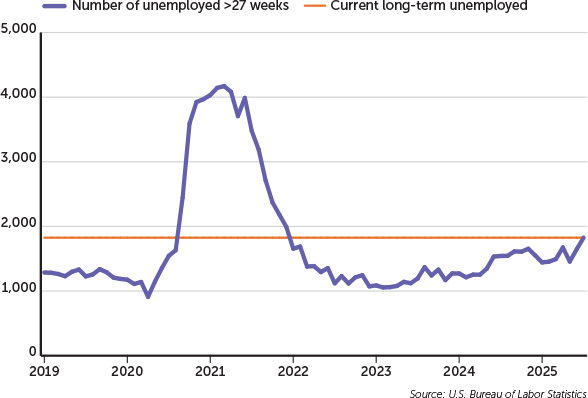
Much of 2025 has been characterized by deteriorating economic sentiment. The most recent ASA Workforce Monitor survey found that almost half (47%) of all Americans believe a recession will occur within the next 12 months, and another 21% believe a recession is already here. Empirically (and thankfully) a recession so far has been avoided, but certain economic developments have damaged popular perceptions about the economy—most notably those surrounding fluctuating trade policy and tariff hikes. While many of the concerns around economic uncertainty have stabilized, negative perceptions on the economic trajectory of the country are not all subjective. Data shows that financial situations for many in the labor force have indeed become more precarious than in years prior. The job market has cooled considerably, and while the unemployment rate is relatively low, the number of long-term unemployed (those jobless for 27 weeks or more) has climbed to 1.6 million as of June 2025—above its prepandemic baseline of 1.1 million in February 2020, according to the U.S. Bureau of Labor Statistics.
Number of Long-Term Unemployed Exceeds Prepandemic Baseline (in thousands)
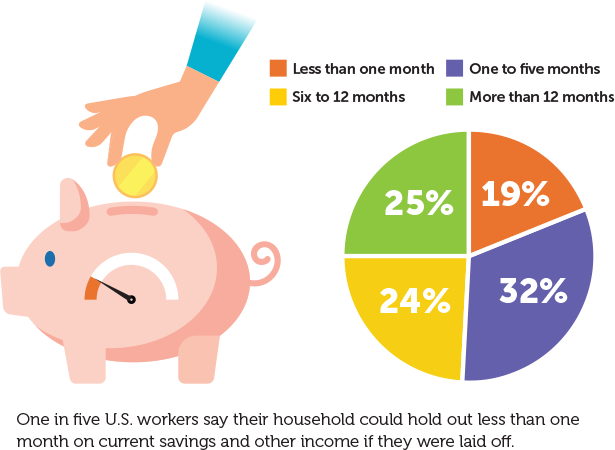
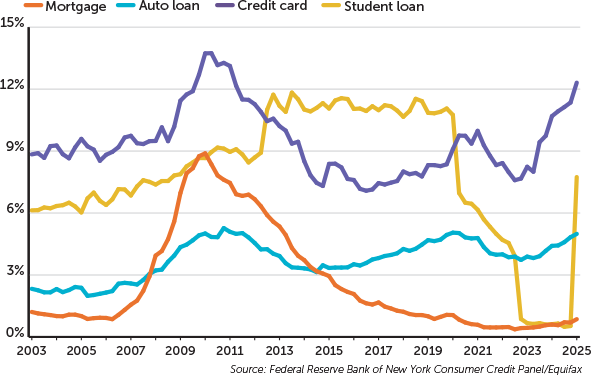
With more workers finding it difficult to re-enter the labor force, many lack the savings to support themselves or their households. The Workforce Monitor found that half (51%) of employed Americans only have five months or less in savings, with one in five (19%) having less than one month’s worth. Notable increases in delinquencies on credit card and student loan debt have risen as well, according to Equifax and the Federal Reserve Bank of New York Consumer Credit Panel. For millions of Americans the verdict is clear: It’s not all subjective sentiment.
Slim Savings
Percent of Balance 90+ Days Delinquent by Loan Type
HOW WORKERS ARE ADAPTING
While a majority of workers believe a recession is coming or has already started, expert forecasts show that is unlikely. Slower growth, however, is widely anticipated. This future is not as bad as a full recession where job opportunities contract across the board for everyone, but slower economic growth means fewer opportunities are created in aggregate—the effects of which, for a growing and increasingly frustrated pool of long-term job seekers, can feel quite similar.
Other workers see how hard it is in the job market and respond by minimizing risk, choosing to stay put at their current positions and depressing labor turnover as a result. Locking in place isn’t the only way workers are adjusting to this economic climate; the Workforce Monitor shows that respondents are altering their planned behavior in large part due to personal anxieties about the economy. While turnover is low, there is a growing proportion of workers who want to minimize risk in another way: by supplementing their incomes via a second job or side hustle.
More than six in 10 (64%) Americans say they plan to get one of the two within the next 12 months, up eight points from the last time the same question was asked in 2024. Financial anxiety in this regard is helping to build a budding “hustler” sector within the economy. While only around one in 20 workers had a second job in 2024, according to BLS, half of Americans (51%) reported having engaged in some sort of personal side hustle, according to the Market-Watch Guides survey conducted on March 13, 2025.
Likelihood to Do Each of the Following the Next Year
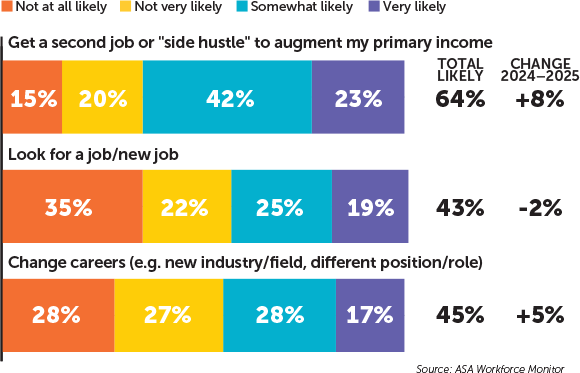
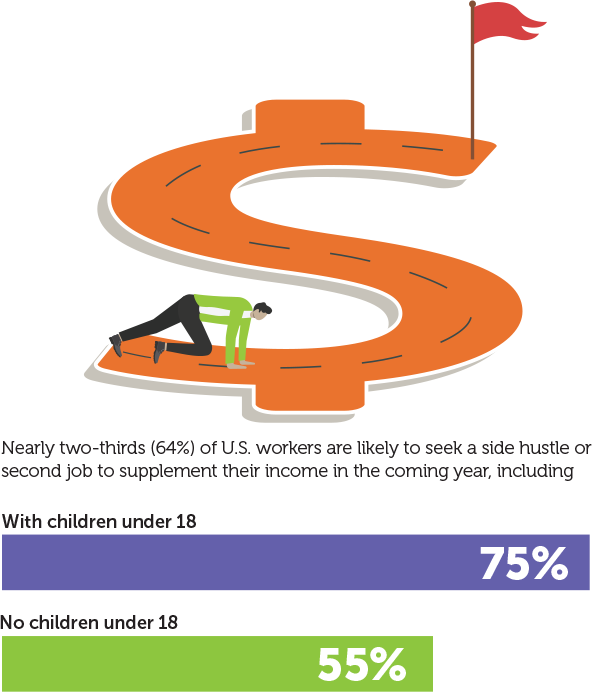
The appetite for opportunities to pad income is there—especially for households most impacted by rising costs. The Workforce Monitor found that three-fourths of parents of children under 18 claimed they aim to acquire a second job or side hustle, compared to 55% of respondents without minor children. Workers with younger children were also more likely to change careers (57%) or look for a new job (60%) within the next 12 months than those without children under 18.
Chasing Extra Income
The reasons why are unsurprising when you consider that households now spend an average of 22.6% of their income on the basic annual expenses to raise a child, up from 19.0% in 2023, according to data analysis from LendingTree. As general inflation pinches everyone’s pocketbook, those with dependents are especially attuned to rising expenses and, therefore, make up a large segment of the vanguard fueling the trend toward methods of income supplementation.
OPPORTUNITIES FOR STAFFING
While the decrease in labor turnover limits staffing opportunities, workers becoming more risk adverse can also represent an opportunity itself with the right methods. Economic precarity among workers is fostering the hustler economy—a sector that recruiters can tap into for motivated talent. In this period of low turnover, staffing companies can devote more effort to reaching out to workers who have jobs and desire to supplement their income. These workers possess valuable skills already recognized by at least one employer, making them a practical choice for clients seeking short-term labor solutions without the long-term commitments that neither side (worker nor employer) currently desires.
To succeed, staffing companies need to tailor their economic message and meet these workers where they’re at, to generate both trust and visibility of the opportunities that the staffing industry can provide them.
Social media-savvy candidates are far more likely to want a second job or side hustle, according to the Workforce Monitor, with 84% of respondents who use social media daily likely to acquire one. Staffing firms with presence on these platforms can better tap into the hustler sector and pitch their value proposition to candidates who may not be familiar with the particular perks of temporary and contract employment. For starters, one of the main draws for staffing assignments—flexibility—very much appeals to parents, who are much more likely to want to supplement their income.
Side hustles can help supplement income, but not all side hustles are equal—and many can even be a relative waste of a worker’s time and effort. Staffing agencies should highlight their ability to introduce and connect these candidates to high-quality opportunities: those offering guaranteed pay and flexibility, as well as career opportunities—things that can set working with your company above gig work apps or trying to figure it out on their own.
SPEAKING CANDIDATES’ LANGUAGE
Adverse conditions for job seekers in the labor market have scared many workers away from jumping to new positions. However, economic difficulties—both real and perceived—also motivate workers to seek alternate forms of employment that may pull them toward the industry, if staffing firms can successfully sell their message. Staffing companies that can speak to candidates’ priorities will be able to better develop their talent pipelines in an era of low turnover, better situating their firms for the future.
is research coordinator at ASA. Send feedback on this article to s******@americanstaffing.net. Engage with ASA on social media—go to americanstaffing.net/social.