Depending on how legal challenges to trade policy unfold, some of these headwinds may ease, better positioning the economy and the staffing industry for growth.
Max Aldrich

Depending on how legal challenges to trade policy unfold, some of these headwinds may ease, better positioning the economy and the staffing industry for growth.
Trade policy is beginning to dominate the news cycle again as the U.S. Supreme Court recently heard arguments that could determine the legality of the ongoing tariff operations. Specifically, the justices are expected to weigh in on the tariffs implemented under the International Emergency Economic Powers Act. According to the Budget Lab at Yale University, a decision invalidating these tariffs would lower the effective tariff rate in the U.S. from 17.4% to 9.1%, potentially reducing the long-term drag on growth from 0.35% to 0.1%, as well as tariff-driven unemployment growth in 2026. On the other hand, the Budget Lab estimates the long-run net revenue of current tariffs to be $2.2 trillion, and invalidating the IEEPA tariffs would reduce that figure by more than half.
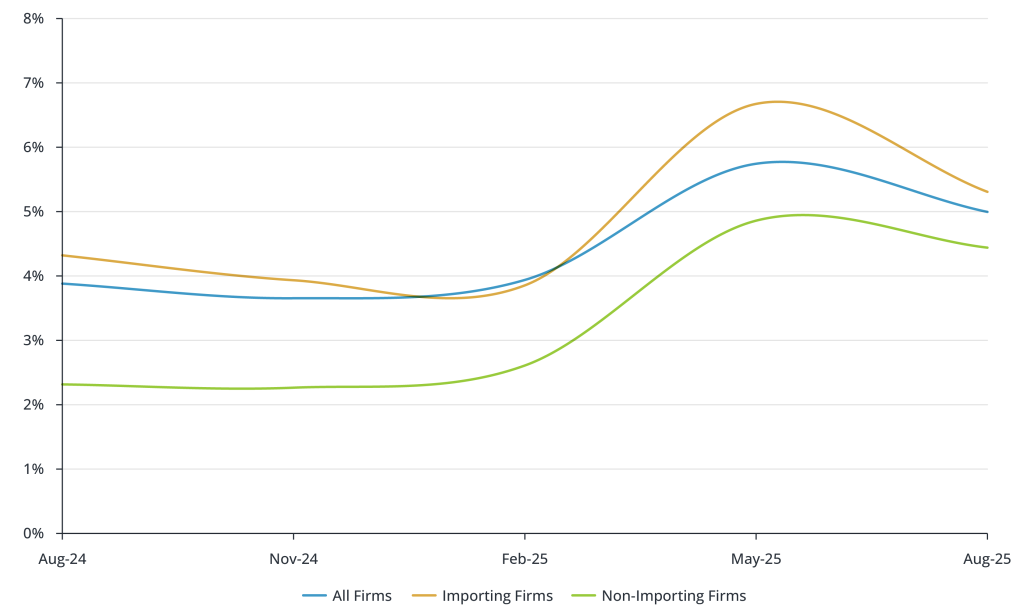
The abrupt manner in which tariffs have been rolled out in 2025 has led to economic uncertainty as well as added inflationary pressures, creating more headwinds for most businesses. In 3Q2025, businesses were expecting prices to grow by 5% in the year ahead, according to the Federal Reserve Bank of Atlanta, easing slightly compared to 5.8% expected in 2Q2025, but still more than a full point above the 3.9% rate recorded a year ago in 3Q2024. Moreover, inflation expectations have risen sharply among non-importing firms, businesses that should be only indirectly affected by tariffs. These sentiments are persuading businesses to keep their hiring plans on hold as labor costs remain elevated while margins are squeezed.
If the Supreme Court decides to overturn elements of the administration’s tariff operations, it could help bolster economic confidence. Still, some uncertainty will persist, as the administration will likely seek other legal justifications to resurrect its unilateral influence over trade policy. For staffing firms, elevated price growth and margin compression will likely keep buyers skittish in the near term, however, depending on how legal challenges to trade policy unfold, some of these headwinds may ease, better positioning the economy and the staffing industry for growth.

Staffing firms should keep a weather eye out for thawing employer hiring activity in the weeks and months ahead with indicators like the ASA Staffing Index, and be ready if client demand picks up.
As of August 2025, the hires rate, job openings rate, and quits rate all stood below their value in January 2020, as employers have workers have settled into a low-fire, low-hire labor market. In fact, ZipRecruiter estimates that median employee turnover has fallen from 177% in 2023 to 50% in 2025. This has been a challenge for the staffing industry, with the temporary help penetration rate falling from 2.10% in March 2022 to 1.57% in August 2025.
Encouragingly, the 2025 ZipRecruiter Employer Survey reveals that a thaw could be coming for the labor market in the year ahead. Nearly two-thirds of the 1,500 hiring decision makers surveyed indicated their business plans to increase headcount in the year ahead, with one in three saying they intend to hire more entry-level workers than any other type of role.
One way hiring may look different in the coming year is a shift toward more skills-based hiring, ZipRecruiter reports. Following years of elevated labor costs and pressure on margins, companies are highly focused to the skillsets offered by new employees, and will determine hiring based on candidates’ ability to do the work assigned to them.
The job-hugging environment has been a challenge for the staffing industry since 2022, but new green shoots are starting to show. While uncertainty still abounds, the year-to-year gap in the ASA Staffing Index has steadily contracted in 2025, and the data show that staffing employment has been higher year-to-year for eight straight weeks. Staffing firms should keep a weather eye on this trend in the weeks and months ahead, and be ready if and when client demand picks up.

 Update for Nov 13, 2025
