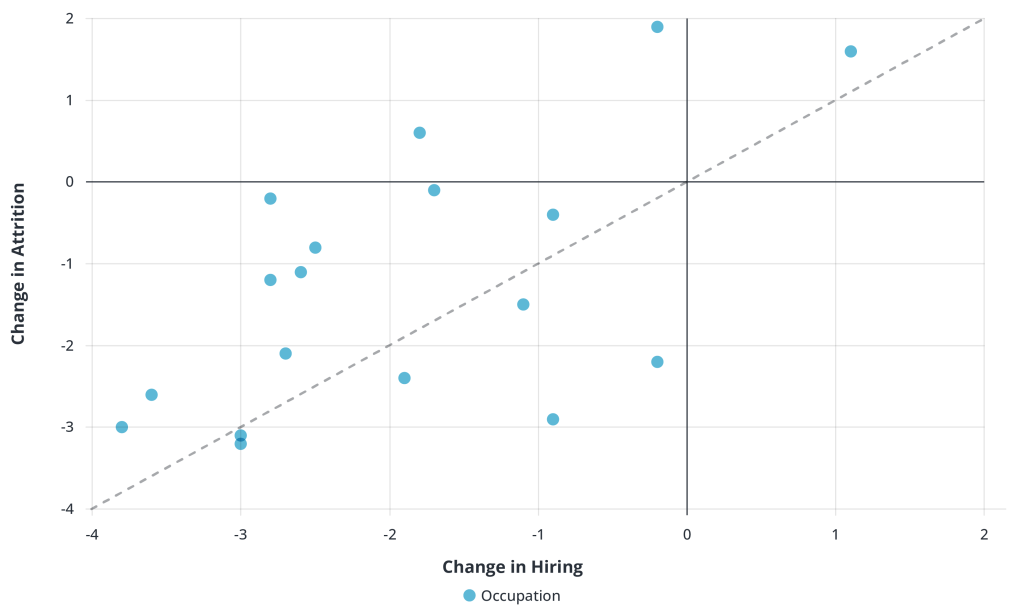
When comparing the year-over-year change between hiring and attrition across 18 major occupation groups, it’s clear that employers are cutting back on hiring but also refraining from firing. Over the past year, only two occupational areas (management and sales) realized declines in hiring as well as an uptick in attrition.
Weekly Economic Outlook
12/04/2025
Where’s the Churn?
One glaring deficiency in government data focused on the labor market is seen within the Job Openings and Labor Turnover Survey (JOLTS)—because it lacks data at an occupational level. The JOLTS data alone does not specify which occupational areas have the majority of job openings, which are realizing more hiring, and, conversely, which occupational areas are realizing more attrition. New data from Revelio Labs provides insight to this gap in publicly-available labor market statistics.
When comparing the year-over-year change between hiring and attrition across 18 major occupation groups, it’s clear that employers are cutting back on hiring but also refraining from firing. Over the past year, only two occupational areas (management and sales) realized declines in hiring as well as an uptick in attrition.” Despite constituting just 11% of occupations within the US labor market, they account for 21% of total employment, which makes these trends more concerning.
Conversely, only one occupational area, business and financial operations, experienced an increase in both hiring and attrition. But since it accounts for only 6% of total employment, it’s no wonder the labor market overall looks much different. For six occupational areas, including protective services, health care support, and farming, fishing, and forestry, attrition declined faster than hiring, which suggests that even in occupations with considerable turnover, employees are hunkering down.
Altogether, these datapoints affirm a frozen labor market which the staffing industry must continue to navigate. Staying on top of the data and appreciating the fact that churn is not the same among all occupations can assist staffing leaders with finding the right opportunities to bring value to their clients.
Hiring vs. Attrition by Occupation
Weekly Staffing Research Outlook
12/04/2025
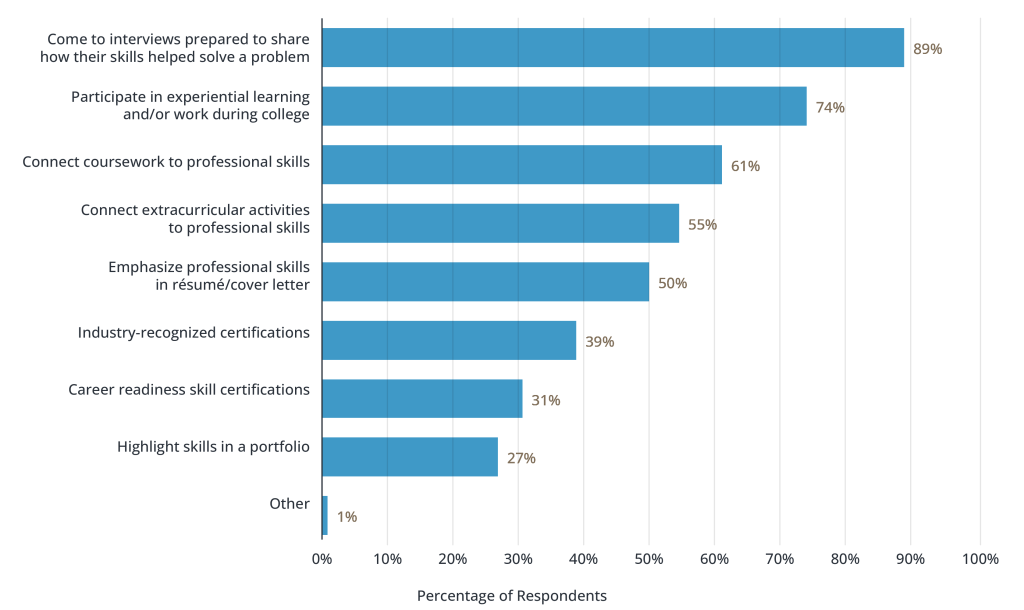
How can recruiters screen candidates or help them prep for interviews in this environment? Coming to interviews prepared to discuss how their skills helped solve a problem can help candidates win over employers who are increasingly using skills-based hiring.
Employers Foresee Slight Hiring Growth for the Class of 2026
Unemployment among recent graduates (bachelor’s degree holders, age 20–24) reached 9.3% in August, according to the U.S. Bureau of Labor Statistics, well above the overall unemployment rate of 4.5% (not seasonally adjusted). While the unemployment rate for recent grads follows a seasonal pattern that peaks in the summer as new grads are entering the labor market, August’s level was the highest since 9.4% in June 2021.
In this environment, employers have muted hiring plans for the class of 2026, as they expect hiring for the class to grow 1.6% from demand for the class of 2025, according to the Job Outlook 2026 Report from the National Association of Colleges and Employers. Furthermore, a plurality rate the hiring market for new graduates as “fair,” compared to last year when a plurality rated it as “good.” This marks the weakest rating for the hiring market since the 2020–2021 academic year.
A majority (60%) expect to keep hiring levels flat from last year, but the share expecting to increase hiring (25%) outweigh those expecting a decrease (14%). Companies planning to grow hiring will do so to keep talent pipelines full and support succession planning, as well as support company growth. This highlights the importance of entry-level hiring, even when reduced business needs and an uncertain economy are barriers to even greater job creation.
How can recruiters screen candidates or help them prep for interviews in this environment? Coming to interviews prepared to discuss how their skills helped solve a problem can help candidates stand out to employers who are increasingly using skills-based hiring.
Top Ways Students Can Demonstrate Skills in a Skills-Based Hiring Process