The week of January 15, 2026

Weekly Economic & Business Outlook

Latest Economic Outlook
  • Caution among clients and talent will remain a fixture of the labor market in 2026.
  • Opportunities in the short term remain concentrated in a handful of sectors.
  • The job market will continue to cool but will come around this year given recent data trends.
Latest Staffing Research
  • Overall, low employee turnover is likely to persist in 2026.
  • Finance and insurance; health care and social assistance; and real estate, rentals, and leasing are industries where demand for workers is outpacing turnover.
  • Many employers are optimistic about growing headcount in 2026, and most are willing to hire temporary workers to support growth.

Weekly Economic Outlook

01/15/2026
Max Aldrich

It’s likely that the job market will continue to cool before economic tailwinds overcome headwinds, so it’s crucial that staffing companies stay agile, data-driven, and proactive in both client and talent engagement to better position themselves for growth.

Max Aldrich

Staffing Industry Will Continue to Feel Double-Sided Pressures in 2026

The staffing industry is still feeling business pressure from both clients and candidates—as clients remain hesitant to hire and candidates remain reluctant to change jobs. Economic uncertainty has pushed job security to the top of workers’ concerns; less than half of U.S. employees (47%) believe they could land a new job within three months if they lost their current one, according to the Federal Reserve Bank of New York. This trend is similar to worker uncertainty seen in the early days of the Covid-19 pandemic. As fewer people are willing to take a chance on a new role, more effort and hands-on reassurance will be required to attract talent and win placements.

For much of 2025, it was a marginally better choice in terms of wage growth for employees to stay at their jobs. According to the Federal Reserve Bank of Atlanta’s Wage Growth Tracker, from February to July, job stayers enjoyed higher median wage growth compared to job switchers. However, as of August, the trend has reverted, with stayers’ wages growing by 3.5% in November compared to switchers’ wages growing by 4.2%. The good news is that despite job market cooling, the data now supports employees taking a chance on moving their skills to other employers. While job security is top of mind for talent, income is still paramount, especially with mainstream concerns about cost of living. Staffing companies that can successfully use hard data to convince talent they’d be better off at a new assignment can better navigate the current environment of low turnover and hiring freezes.

It’s important to note that the labor market will likely continue to cool, at least in the short term. Employers will likely remain cautious due to many factors, but especially economic uncertainty. Also: While the Economic Uncertainty Index may have come down from its peak in April 2025, its recent value of 281 in December is comparable to Covid-19 times but above the baseline of 109 in October 2024. The uneven concentration of hiring within the job market adds another significant challenge. The most recent ADP data (December 2025) reports job gains in education and health services (39,000) and leisure and hospitality (24,000), while information (-12,000) and professional business services (-29,000) continue to contract.

For staffing firms, this could mean devoting attention and resources to sectors experiencing growth or locating stable niches within contracting or stagnating sectors. It’s likely that the job market will continue to loosen before economic tailwinds overcome headwinds, so it’s crucial that staffing companies stay agile, data-driven, and proactive in both client and talent engagement to better position themselves for growth as the industry continues to find its footing.

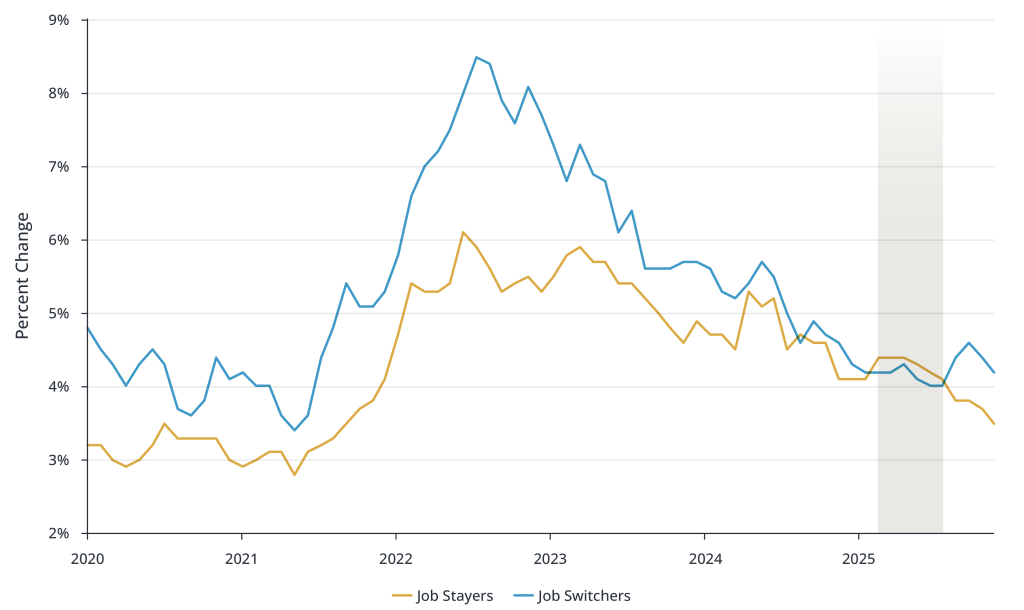
Wage Growth: Three-Month Moving Average

Wage Growth: Three-Month Moving Average
Source: Federal Reserve Bank of Atlanta

Weekly Staffing Research Outlook

01/15/2026

While the labor market remains cool at least to start 2026, there are pockets of opportunity for staffing firms to place in certain sectors now, and business leaders are optimistic about hiring growth and open to using the staffing industry to support that growth in the months ahead.

Tim Hulley

Job Hugging to Continue in 2026, With Variation by Industry

Job hugging, or the tendency of workers to stick with their current job as opposed to looking for a new one, is likely to remain a key workplace dynamic to start 2026. This was the case in late 2025: The quits rate reported by the U.S. Bureau of Labor Statistics measured 1.8% in October, the lowest since 2014 (excluding the pandemic-impacted months of April and May of 2020). This is understandable given the current weakness in the labor market, with anemic hiring levels and unemployment creeping up.

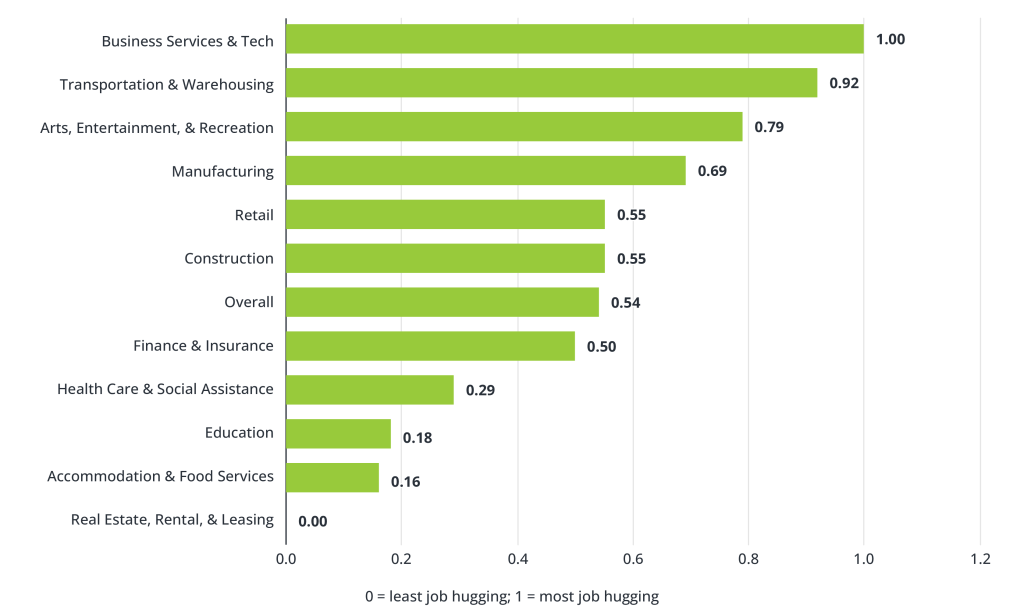
The job hugging trend is not the same in all industries. In its 2025 End-of-Year Top Jobs Report, Payscale calculates job hugging as a function of the quits rate and incumbent growth in a given industry—with employees in business services and technology leading the way (both employment growth and voluntary turnover have contracted sharply). Other industries seeing continued job hugging include transportation and warehousing; arts, entertainment, and recreation; manufacturing; construction; and retail. On the other hand, accommodation and food services and transportation are areas where job hugging is lower but this is mainly due to higher despite coincident lower employer demand. However, finance and insurance; health care and social assistance; and real estate, rentals, and leasing are industries where demand for workers is outpacing turnover, offering potential opportunity for staffing firms.

For their part, many employers have a positive hiring outlook for 2026, according to a recent survey conducted by Express Employment Professionals, which found that two-thirds of employers plan to increase headcount in the first half of 2026. A quarter of companies plan to hire temporary staff in 2026, and eight in 10 would be willing to do so to meet business needs in the year ahead. Therefore, while the labor market remains cool at least to start 2026, there are pockets of opportunity for staffing firms to place in certain sectors now; business leaders are optimistic about hiring growth and open to using the staffing industry to support that growth in the months ahead.


Job Hugging Score By Industry

Job Hugging Score By Industry
Source: Payscale

Economic Calendar

Real Time Economic Calendar provided by Investing.com.
Past Issues
Loading Issue...
Meet the Research Team
  • Noah Yosif
  • Tim Hulley
  • Max Aldrich
    Max Aldrich