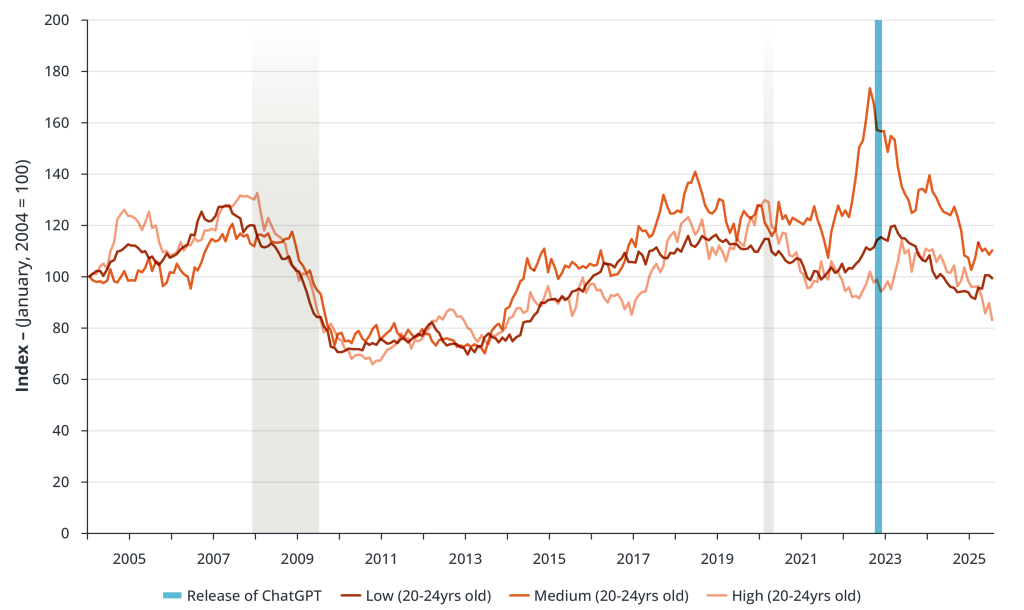
Job-finding rates within occupations with a high risk of displacement from AI are falling among young workers. And while these trends also owe to broader stagnation in labor market activity, the substantial difference between occupations at a high-risk of AI displacement compared to those with less risk does suggest that AI is making it more difficult for young workers to secure a foothold in today’s career ladder.
Weekly Economic Outlook
01/22/2026
Artificial Intelligence: Another Artificial Damper on Job Opportunities?
Despite mixed projections regarding its actual capabilities to bolster productivity while seamlessly replacing humans, many employers have embraced AI as the future of work. In fact, many politicians and business leaders will be discussing such trends at the upcoming World Economic Forum in Davos, Switzerland.
While AI might not be to the capacity that many currently think, the buzz around its potential is creating seismic shifts within the labor market. Research from the Dallas Federal Reserve shows that job-finding rates within occupations with a high risk of displacement from AI are falling among young workers. And while these trends also are due to broader stagnation in labor market activity, the substantial difference between occupations at a high risk of AI displacement compared to those with less risk does suggest that AI is making it more difficult for young workers to secure a foothold in today’s career ladder.
If sustained, these trends could have major consequences on labor market activity. First, young workers might not feel the same sense of loyalty to their employers if they continue to feel just one step ahead of being replaced by AI. Next, these trends could increase disparities within the labor market, with some young workers in a perpetual state of job insecurity relative to other peers based on their occupation and the rate of AI displacement. Finally, younger workers might also be more open to flexible work options to minimize disruptions to their employment and career stemming from AI.
Job-Finding Rates Among Young Workers, by Occupational Risk of Displacement Due to AI
Weekly Staffing Research Outlook
01/22/2026
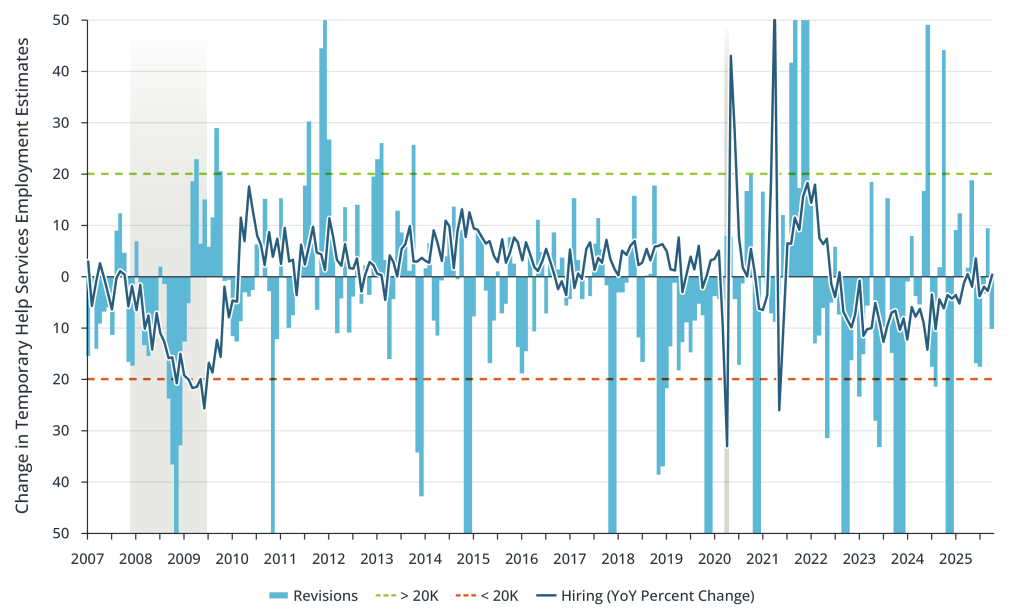
Most revisions in 2025 have been to the downside as the staffing industry is grappling with a well-known problem of less churn in the labor market. But they are quite small, and not moving the needle very much from month to month.
Why So Many Revisions to Temporary Employment?
Most labor market data falls within one of two categories: 1) highly accurate but not very timely, or 2) very timely but not highly accurate. The monthly Jobs Report published by the United States Bureau of Labor Statistics is no exception to this rule, and definitely falls within the former category. The explanation for its lack of timeliness has to do with the methods by which monthly payroll data is collected – typically, late responses, corrected payroll counts, and data processing fixes beyond the initial month of estimation lead to post-release revisions based on a more accurate sample.
These necessary adjustments affect nearly every sector and industry included in the jobs report (NAICS 561320) as well as temporary help services. Therefore, it is important to remember for any given month that estimates of temporary employment are likely to change as more data becomes available. And there are a couple of helpful rules when thinking about how these estimates will change.
First, temporary help services employment is more likely to be revised upward when hiring rises, and is more likely to be revised downward when hiring falls—simply because the staffing industry depends on increased churn within the labor market. For example, since 2022, when the labor market began to realize a progressive slowdown in hiring, estimates of temporary employment were revised upward for 14 out of 36 months. Second, temporary help services employment does not typically experience major revisions beyond initial estimates. For example, since 2007, 80% of revisions to temporary help services employment have been below 20,000. Third, where temporary help services employment does realize major changes in excess of such a level, it is usually in a recession, where economic conditions tend to be more volatile than normal.
What can be said about revisions today? Most revisions in 2025 have been to the downside as the staffing industry continue to grapple with less churn in the labor market. But they are quite small, and not moving the needle very much from month to month. But with five of 14 upward revisions being in 2025, alongside a stabilization in hiring, it could suggest that a recovery is very much on the horizon for temporary help services employment in 2026.
Monthly Revisions to Estimates of Temporary Help Services Employment