While it is a rational response to uncertainty by employers, the broader trend of prioritizing productivity over headcount does raise the bar for staffing firms as clients want to see more value per placement.
Max Aldrich

While it is a rational response to uncertainty by employers, the broader trend of prioritizing productivity over headcount does raise the bar for staffing firms as clients want to see more value per placement.
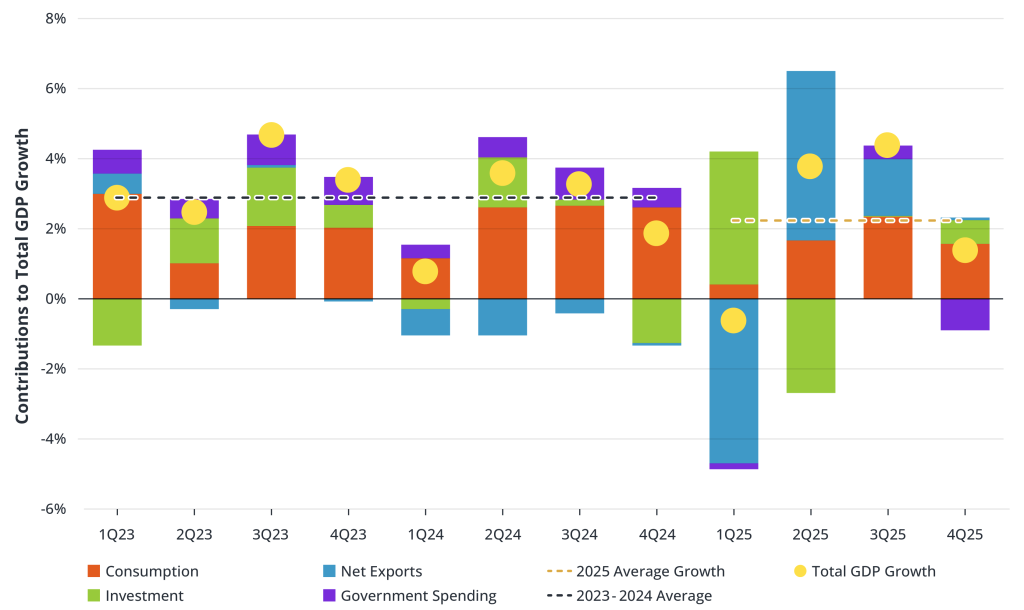
The U.S. economy ended 2025 by clearing a few more road bumps as evidenced by data released by the Bureau of Economic Analysis (BEA). While the economy grew faster than expected in the second and third quarters, it also grew much slower than anticipated in the last quarter. Real GDP growth in the fourth quarter of 2025 came in at more than a full percentage point below experts’ estimates (1.4% vs. 2.5%)—and, in the first quarter of 2025, the economy even shrunk by 0.6%. This up-and-down pattern is largely representative of the volatility and the uncertainty associated with current economic conditions.
To be specific, the impact of the historically long government shutdown last year was clear in the BEA’s report, which noted that decreases in government spending cut off nearly a full point of growth (0.9%) during the fourth quarter of 2025. On the other hand, consumer spending helped keep growth up by contributing 1.6 percentage points, but this is also less than the 2.3 points measured during the third quarter. In comparison, the average quarterly contribution from consumption to GDP growth was 2.1% from 1Q2023 to 4Q2024. In addition to this slowdown in consumption, core inflation rose 3.0% year-over-year in December compared to 2.8% in November, further reflecting persistent cost pressures on households and businesses.
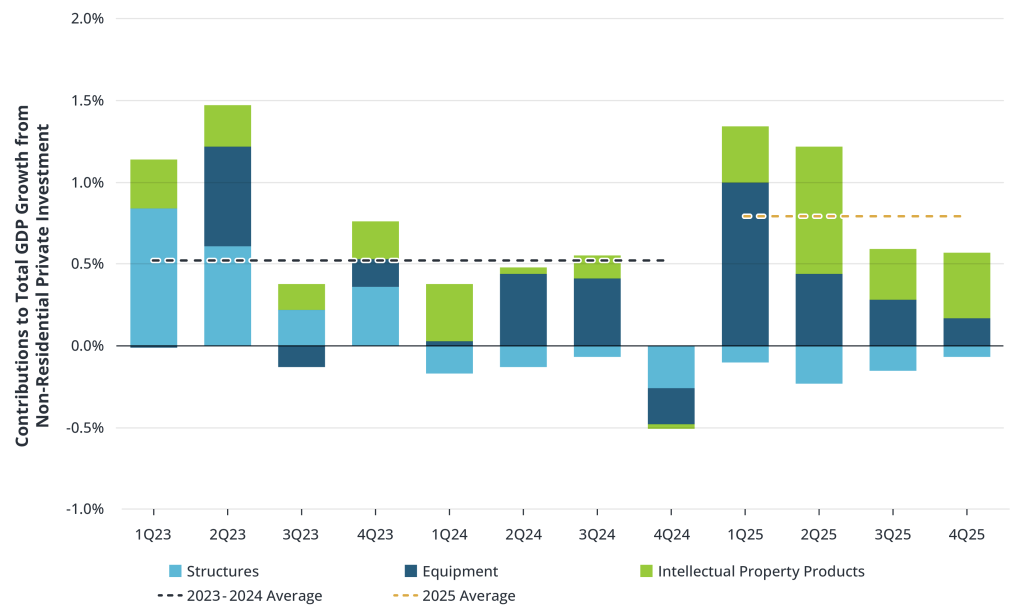
Nonresidential private investment also helped boost growth in 4Q2025, adding slightly more than half a point in total growth. These were mainly concentrated within intellectual property products such as software and research and development investments, which suggests that companies remain committed to chasing productivity gains as a response to rising labor costs and economic turbulence. While it is a rational response to uncertainty by employers, the broader trend of prioritizing productivity over headcount does raise the bar for staffing firms as clients want to see more value per placement.
Also in the mix is the recent Supreme Court ruling that much of the emergency “reciprocal” tariffs are unconstitutional. While reduced tariffs could help bring down inflation, the decision has spurred fresh uncertainty as the administration has pledged to continue exercising its tariff-setting power via other avenues. In short, the bumpy ride the economy went over in 2025 may still have a few surprises left.

Given the rise of skills first hiring and the rapid evolution of skills needed for different jobs, staffing professionals need to stay abreast of desired skills in the workforce. Those that do will be well-positioned to source the right candidates for clients.
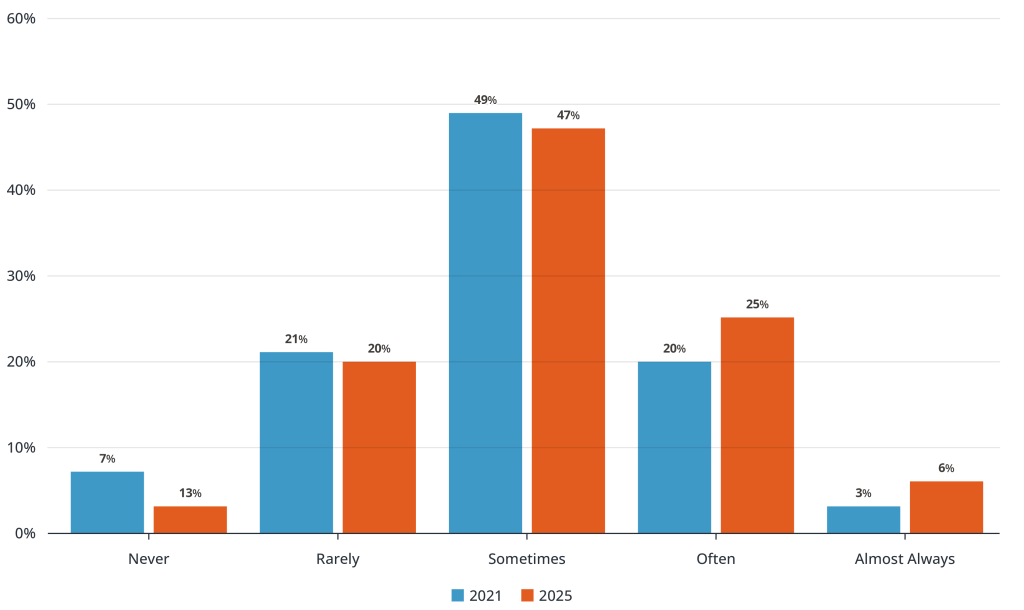
Skills-first hiring approaches continue to grow in popularity among employers, according to new research from the Society for Human Resource Management. In 2025, 78% of HR professionals said their hiring processes included consideration of skilled credentials at least sometimes, up from 72% in 2021. Three in 10 (31%) said skilled credentials are used often or always, up from 23% in 2021. When asked in the 2025 survey which factors are most important in hiring decisions at their company, HR professionals ranked experience at the top of the list, followed by relevant skills or competencies. Educational background, which was fourth in 2021, fell to sixth in 2025.
This rise in the prevalence of skills-based hiring presents two major challenges for employers. First, the skills needed for work are evolving rapidly. In fact, Lightcast reports that the average job’s skills requirements changed 33% from 2022 to 2025. AI is a major driver of this shift, with HR executives, HR professionals, and supervisors all telling SHRM that AI will change the skills considered valuable in the workforce. Companies are expected to prioritize hiring workers with skills in AI-related tasks, and they see AI increasing the need for hard/technical skills in hires. At the same time, AI will increase the need for workers with power/soft skills.
Second, as skills become more important in the hiring process, gauging whether a worker has the right skills will be critical for effective hiring. To that end, HR executives, HR professionals, and supervisors each see certifications, on-the-job training, and real-time skills and competency assessments all being important over the next three years. Already, a majority of HR professionals report that their firms are using behavioral interviewing, clearly defining skills for each role, emphasizing skills over degrees or years of experience in job postings, and using skills assessments to pursue a skills-first hiring strategy.
Given the rise of skills first hiring and the rapid evolution of skills needed for different jobs, staffing professionals need to stay abreast of desired skills in the workforce. Those that do will be well-positioned to source the right candidates for clients.