The week of March 11, 2026

Weekly Economic & Business Outlook

Latest Economic Outlook
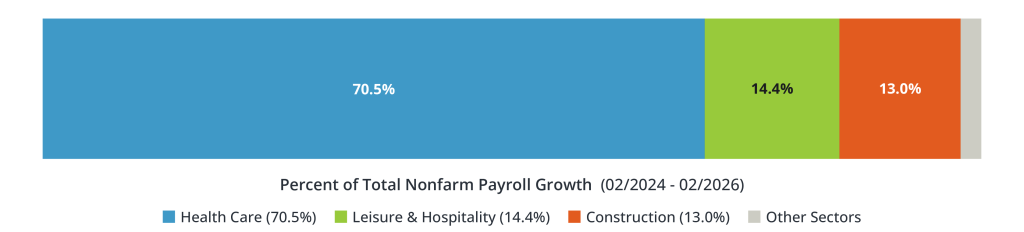
  • Over the past two years, most job gains have come from just three sectors: health care; leisure and hospitality; and construction.
  • Recent health care job losses were driven by Kaiser Permanente strikes, and construction was negatively affected by severe winter weather.
  • Although unemployment remains low, the labor market’s dependence on a handful of sectors, companies, and uncontrollable conditions poses a major risk.
Latest Staffing Research
  • Many organizations are finding it difficult to balance worker pay expectations against financial constraints.
  • Companies feel confident in their pay benchmarking strategy, with the average company using three sources for market intelligence.
  • AI skills have shown up in job postings and driven new roles, but have yet to correspond to pay increases.

Weekly Economic Outlook

03/11/2026

Although the labor market has not yet seen an uptick in unemployment or layoffs, the fact that its momentum rests on a handful of sectors, companies, as well as conditions beyond their control is a major risk that could lead to such results.

Noah Yosif

A Predictable Failure of the Labor Market

Friday’s no-good, very-bad jobs report was the result of a labor market which has, for far too long, relied on a handful of sectors to produce the majority of its job gains. Over the past two years, cumulative job gains has been limited to three sectors: health care; leisure and hospitality, and construction. In years prior, government was also a major contributor to overall job gains prior to significant reorganization of the federal workforce. This consolidation of new opportunities in the labor market led to a very predictable failure that was realized in February’s jobs report.

Health care lost 28,000 jobs, largely due to strikes among nurses as well as other frontline staff at Kaiser Permanente that were only recently resolved. Similarly, inclement weather affecting large swaths of the Northeast and Midwest forced disruptions in construction as most such work is often done outside. While health care and construction face unique labor dynamics, namely, persistent personnel shortages within key positions like nursing or craftsmen, which has enabled nonfarm payrolls to often appear better than they really are, it has also left the labor market one strike or snowstorm away from a major collapse as was evidenced by February’s jobs report.

Although the labor market has not yet seen an uptick in unemployment or layoffs, the fact that its momentum rests on a handful of sectors, companies, and conditions beyond their control is a major risk that could lead to such results. Until policy and the economy can convince more employers to begin opening their payrolls again, these unique risks could become more pronounced in future reports.


Contributions to Nonfarm Payroll Growth by Sector

Contributions to Nonfarm Payroll Growth by Sector
Source: U.S. Bureau of Labor Statistics

Weekly Staffing Research Outlook

03/11/2026

With many companies using multiple sources to benchmark their pay, staffing professionals need to be prepared to discuss the market rate for a given role with clients, or help bridge the gap between a candidate’s targeted wage and what the market reality is.

Tim Hulley

2026 Compensation Outlook: Caution, Benchmarking, and the AI Question

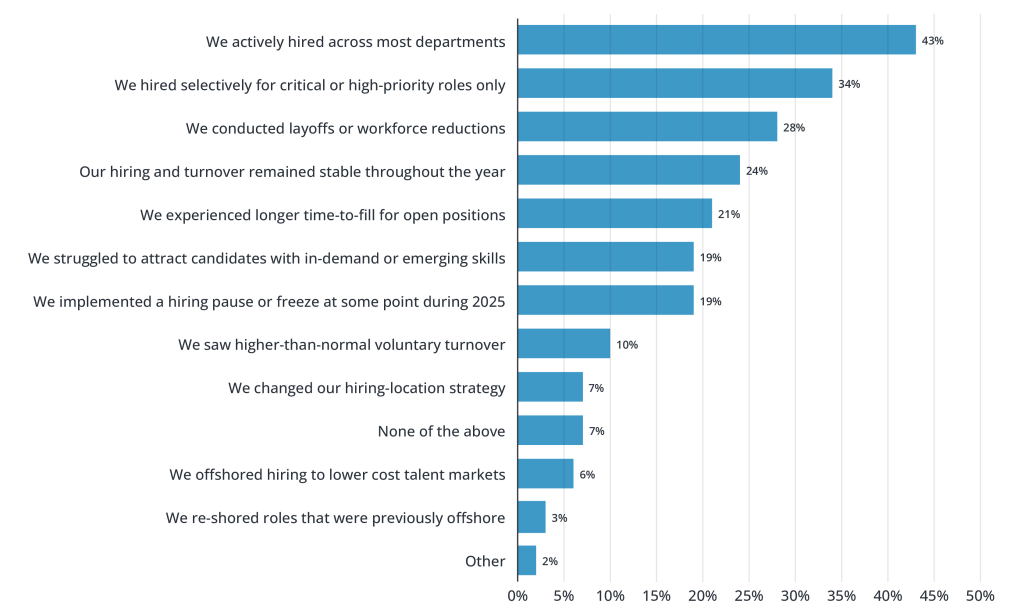
Companies were cautious about hiring in 2025, according to Payscale’s 2026 Compensation Best Practices Report: 43% said they hired actively across most departments last year, but a third hired selectively for critical or high-priority roles only. Workers were conservative as well, with voluntary turnover hitting just 8%, one of the lowest rates ever recorded. In a cooling labor market and challenging business environment, organizations are facing several key challenges related to compensation strategy.

Many organizations are finding it difficult to balance worker pay expectations against financial constraints, with 51% citing this as their top challenge. Contributing to this challenge is the prevalence of unverified sources spreading incorrect information about salary and driving potentially unrealistic pay expectations. To combat this, it is important to benchmark salary bands, preferably by industry. On average, companies used three different data sources to gauge the market rate for different roles, with two-thirds of companies feeling confident in their pay benchmarking strategy.

One skill area that has yet to impact pay trends is AI. More than half of companies report offering no additional premiums, bonuses, or equity for employees who have built out their AI skillset, even as companies are beginning to rewrite roles to require AI skills, or create new AI-specific roles entirely. As more becomes known about the value of AI skills, it may be that firms will need to update their pay considerations to account for these skills in hiring.

In today’s labor market, understanding the pay and benefit landscape is crucial for staffing professionals. With many firms using multiple sources to benchmark their pay, staffing professionals need to be prepared to discuss the market rate for a given role with clients, or help bridge the gap between a candidate’s targeted wage and what the market reality is.


Workforce Decisions in 2025

Workforce Decisions in 2025
Source: Payscale

Economic Calendar

Real Time Economic Calendar provided by Investing.com.
Past Issues
Loading Issue...
Meet the Research Team
  • Noah Yosif
  • Tim Hulley
  • Max Aldrich
    Max Aldrich