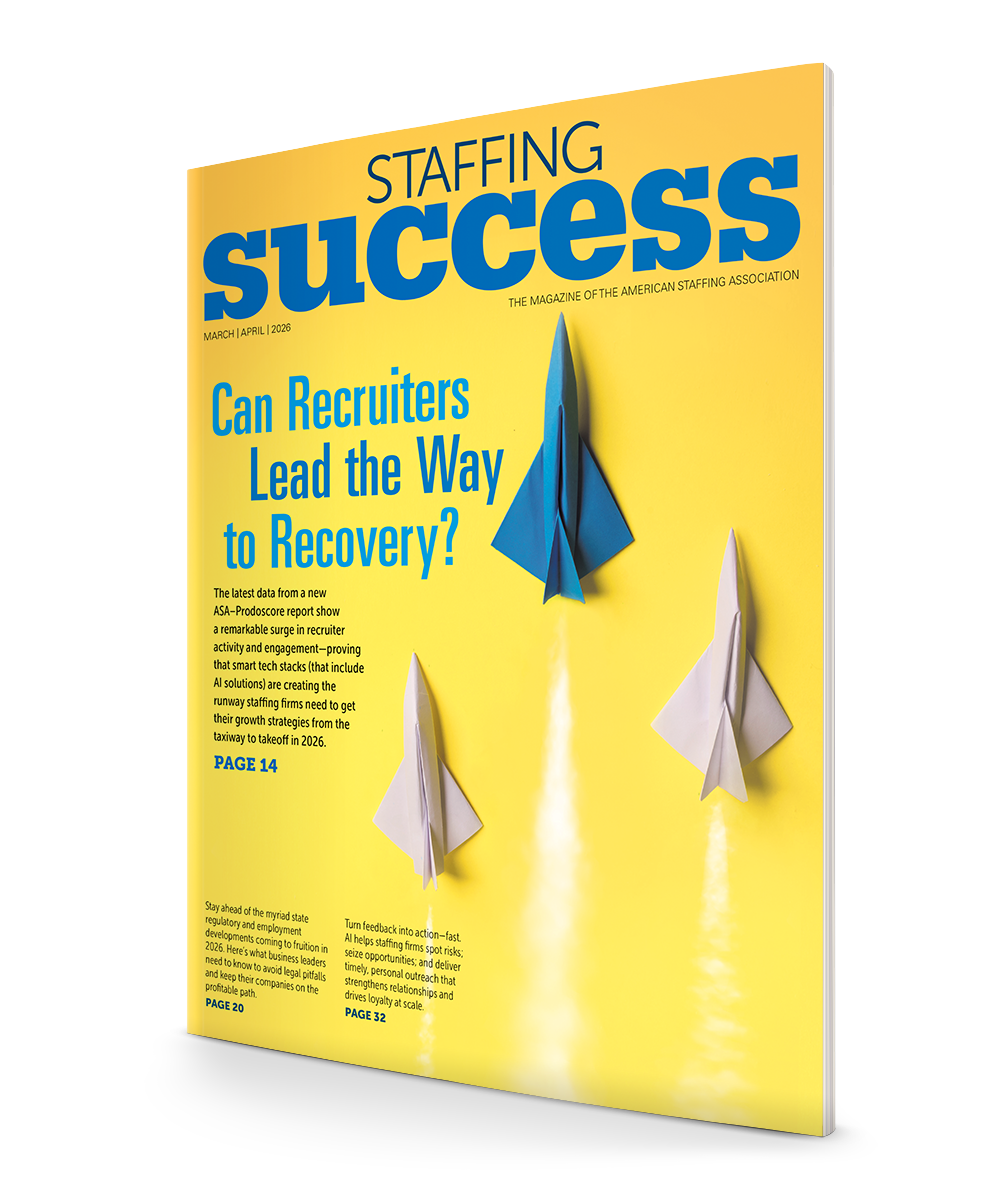
As a staffing executive, you may see your people making calls all day. But are they getting anything done? When firms measure productivity, “it tells them if they’re hitting their targets for growth,” says ASA chief economist Noah Yosif.
“Whether a staffing company is reaching out to enough candidates, whether they are able to get enough new orders—all these productivity measures help them understand whether they are positioned to hit their targets,” he says. In fact, research by the Performance Management Research Group shows that companies with strong performance management systems in place are 51% more likely to outperform their competitors financially.
With a growing emphasis on productivity as a measure of success, ASA teamed with employee-centric data intelligence firm Prodoscore to produce its recent Staffing Productivity Report. The findings describe how top performers operate, and what staffing firms can do to drive productivity in a challenging marketplace.
Here we explore those findings with a variety of staffing executives, who share their experiences and insights.
Measuring Productivity
Nationwide and across industries, productivity was up almost 5% in late 2025, according to the U.S. Bureau of Labor Statistics. Technology plays a key role, with early artificial intelligence implementations helping workers to operate more efficiently across the board.
Staffing firms can gain a competitive edge when they track productivity within their own organizations. “A lot of the data they need to measure their strengths and weaknesses is in their own backyard,” Yosif says. “It’s things like: How much time are you spending on a phone call with a client? How many emails are you putting out to candidates in a given week? They can measure productivity simply by taking stock of their day-to-day activities and setting benchmarks.”
"You can’t just throw people or technology at a problem. To keep productivity strong you have to be tactical about what you’re adding to your tech stack. It’s about understanding what you’re implementing and whether it makes sense for your organization."
—Cody Cope, director of recruiting and training, AccountStaff Inc.
At TRC Talent Solutions, president and chief executive officer Brian Robinson dives deep into that data. “I have submittals, interviews, offers, and placements. We track it in Power BI, so we have it almost in real time,” he says. “That gives us a chance to look at what’s going on during the week; then you can have your one-on-ones at the end of the week and say, ‘How did things go?’ You get more of the story than the numbers, and you use that to coach.”
For Cody Cope, director of recruiting and training at AccountStaff Inc., productivity tracks to results. “Those are submissions that lead to interviews, which lead to placements,” he says. “It’s not about the sheer activity. It’s really about a three-to-one ratio that we look for: Three submissions or three interviews to one placement. And when those numbers align, that’s when we know we’re driving real impact.”
And at OneSource Staffing Solutions, director of staffing operations Kelly Gauntlett likewise tracks productivity, but with a slightly different emphasis. “We measure on team rather than individual, because team is more important to us,” she says. In evaluating team productivity from the sales perspective, “we look at client meetings and then we look at proposals sent versus business won. On the business development side, that tells us whether our pricing is in line,” she says. “On the recruiter side, it tells us whether all the effort is transferring to results—because really that’s all that matters.”
It’s Not ‘One Size Fits All’
Staffing firms succeed when they measure and motivate productivity. But that’s not a “one-size-fits-all” proposition. ASA research found that the challenges and approaches to productivity vary by the size of the firm.
TRC Talent, for example, is a large firm with a diverse customer base. The challenge there lies in allocating staff to the areas where they can be most productive. At any given time, “you’ll be up over here and down over there, and you need to target toward what is working,” Robinson says. “It’s about getting the right people in the right order.”
At OneSource Staffing, meanwhile, Gauntlett says being a mid-sized firm has its advantages. “We can move quickly, whether it’s implementing technology or having to change headcount or make operational changes,” she says. While that helps drive productivity, it takes some finesse. “The biggest challenge is keeping up with technology—it’s flying at us so fast. Which product do you pick? Every day another tool is being introduced.”
At smaller firms, every choice matters. “You can’t just throw people or technology at a problem,” Cope says. To keep productivity strong, “you have to be tactical about what you’re adding to your tech stack. It’s about understanding what you’re implementing and whether it makes sense for your organization.”
The big takeaway here: “There’s no one magic bullet for increasing productivity,” Yosif says. “It very much is dependent on the individual characteristics of the company.”
Empowering the ‘ACEs’
ASA research finds that top-performing recruiters can be characterized as “ACEs”—they are accessible, communicative, and efficient in their use of tools and technology. For many, that means putting a heavy emphasis on ensuring recruiters are getting maximum value from their application tracking system (ATS).
“There’s always hidden gold in our ATS. Being a big company, there’s always a candidate there”—and the most productive people know how to mine that gold, Robinson says. “They know where the database is good and where it’s not, because they’ve tested it. They won’t go down a week-long rabbit hole if it’s not working. They’re not going to waste their time.”
Cope sees the same within his team. “Our top performers are always the ones that leverage the ATS the most. That keeps the candidate data organized and searchable, and it allows the recruiters to move quickly while staying as efficient as possible,” he says. That has a direct impact on how the firm operates. “When we have a new trainee, that is literally the core of the training. We go over how to use the ATS, and make sure they’re using it as much as possible.”
According to the Staffing Productivity Report, exemplar recruiter success is driven by several factors, including messaging and customer relationship management (CRM) or ATS discipline. On the high end, exemplary recruiters are recording 100 to 150 ATS activities and more than 200 internal chats per week, ensuring their pipeline of candidates is always up-to-date and they are leveraging their team members to drive success.
Gauntlett focuses especially on the “accessible” and “communicative” aspects of ACEs: If people are accessible and communicative, then everyone can make better use of the tools. “If you work in a team, you maybe have someone who’s stronger on the tool side,” she says—and everyone can be more productive when those skills are shared across the team.
While technology can help drive productivity, it’s worth noting that “more technology does not always mean more productivity,” Yosif says. “What we see is that there’s a sweet spot of about seven or eight different tech tools that your top-performing recruiters use, and they use these different tools for very specific purposes (whether that is managing different components of an interview or reaching out to clients).”
For those looking to build up their tech stack with productivity in mind, “start with where you want to be and then work backward,” he says. “Have a specific problem in mind: ‘I’m spending too much time looking at résumés’ or ‘I need help planning my day-to-day.’ Once you have that problem in mind, you’re then going to have a better understanding of what technology is out there that can solve that problem.”
Optimizing Hybrid Productivity
Staffing executives may worry about the impact of remote and hybrid work on productivity—and maybe with good reason. “The number one consideration is whether that’s going to disrupt or enhance accessibility. You do not want to disrupt the flow of communication,” Yosif says.
For Cope, the ATS offers a way to defuse that concern. “The ATS allows us to keep our communication seamless between on-site and remote staff,” he says. “When you’re putting a note in, the person on the other side is notified immediately. It’s sometimes quicker and more effective than even in person.”
Visibility within the ATS “allows our managers and recruiters to stay on the same page regardless of where they’re working,” Cope says. “A lot of the struggles with remote work come down to: Are people being productive when they’re not being ‘watched’? In our world, because of that ATS, you see what everybody’s doing. It’s all out in the open and it’s all collaborative.”
Robinson flips the script: While his people are 95% in-office, he offers remote work as a reward for productivity. “We let them earn freedom,” he says. “Those high performers aren’t going to get fired for not coming in some days.”
To ensure off-site workers can be productive, “make sure that they’re using the right technologies,” Yosif advises. “Remote work ‘works’ because folks are able to leverage technology. So make sure that you’re using the right tech stack, one that allows for recruiters to be accessible and also to do all facets of their job—and do them well.”
Productivity as a Market Indicator
By measuring productivity, staffing executives can track how well people and teams are performing and can adjust as needed. But productivity serves another purpose as well: It can be a helpful indicator of industry trends.
“By looking at the staffing industry at large through Prodoscore’s data, we found that an increase in productivity can also signal an increase in activity within the staffing space,” Yosif notes. “When recruiters are doing more of what they do, it also portends more activity within the industry at large.”
Robinson leverages such insights to drive strategy. For example: The industry has moved toward medical (while pivoting away from IT), and he’s followed those signals in the data. “We’re very heavy in a lot of hospitals now. We’re still doing clerical mostly (not patient stuff), but there’s a ton of business there—and there wasn’t anything there last year,” he says. “If you’re paying attention, you’ll see that stuff.”
At OneSource Staffing, productivity metrics likewise empower management to pivot. “If we see activity in, say, automotive, then we’re going to start targeting those industries in our other areas,” Gauntlett says. “It could be supply chain; it could be warehousing: Whenever we’re seeing an increase in one market, then as a team we use business development to target those” in other markets.
Top Productivity Analysis Tips for Staffing Leaders
Data from the inaugural ASA–Prodoscore Staffing Productivity Report, first published in March and set to be released on a quarterly basis, point to four strategic actions that can help drive productivity at your firm:
- Re-Evaluate Your Productivity-Versus-Engagement Balance: While overall productivity may be down, a surge in engagement (calls/meetings) is a powerful leading indicator. Are your teams focused on the right activities to build a strong pipeline in the first half of 2026? Benchmark your call and meeting volume against the industry.
- Optimize Productivity of Your Hybrid Employees: There is no one-size-fits-all solution. Analyze your own productivity data for in-office versus remote work. Small and medium-sized firms should not abandon in-office advantages, while large firms can expand faster and attract more talent with a remote/hybrid model.
- Conduct a Tech Stack Adoption Audit: Before investing in new software, ensure your team is fully leveraging your existing ATS, job boards, and AI tools. Is the 9x increase in daily AI usage reflected in your team’s workflow?
- Leverage Your Data as a Forecasting Tool: Monitor your internal email and meeting trends as leading indicators to anticipate market shifts, adapt your desks’ capacity, and stay ahead of the competition.
The full report summarizes recruiter productivity, work patterns, and AI tool usage trends, providing valuable benchmarks for staffing firms to gauge recruiting desk progress, identify opportunities for improvement, and augment employee growth. Learn more and get your copy at americanstaffing.net/asa-prodoscore.
"For those looking to build up their tech stack with productivity in mind, start with where you want to be and then work backward. Have a specific problem in mind…Once you have that problem in mind, you’re then going to have a better understanding of what technology is out there that can solve that problem."
—Noah Yosif, chief economist, ASA
From an office-level perspective, “let’s say that we have open orders and we don’t have enough applications or qualified applications,” she says. When productivity drops, the company adjusts. “Maybe we’re going to do job fairs, or maybe we’re going to use that information to do something different—because posting and praying doesn’t work. You can’t just rely on your job boards.”
Cope does much the same, tapping productivity measures to gauge the landscape. The firm uses that data “to spot specific trends like seasonal hiring patterns. That really helps us forecast demand, so we’re prepared for that every year,” he says.
Still, Cope offers a word of caution here. “That data is useful, but sometimes staffing firms over-complicate the data,” he says. “Some people look at the trends and make decisions that really aren’t relevant.” Executives may focus “way too much on meetings, statistics, key performance indicators (KPIs), metrics—which are all important, but you can lose sight of the work itself, the productivity itself. For us, it’s about using the right metrics to make better decisions.”
, a freelance writer based in Annapolis, MD, is a regular contributor to Staffing Success. Send feedback on this article to s******@americanstaffing.net. Engage with ASA on social media—go to americanstaffing.net/social.