Since the end of the Great Resignation of 2021–2022, the staffing industry has been navigating a slow, but steady, cooling period in large part driven by a shift in leverage away from workers and toward employers. As clients have become more cost conscious, hiring has grown more selective and competitive, much to the staffing industry’s detriment. Not long ago this dynamic was on its head, as leverage laid more with workers whom staffing companies helped place where they were needed most. The erosion of worker leverage in recent years helps to assign a root cause to some of the industry’s recent challenges.
The labor leverage ratio (LLR) is the total number of worker-initiated quits per every employer-initiated layoff and discharge. As the ratio increases, so, too, does staffing employment as job seekers become more confident about their opportunities in the labor market and clients require vacated positions to be refilled.
However, ASA estimates of sector-level staffing employment reveal that this shift in leverage hasn’t affected all parts of the industry in a uniform way. Identifying these differences between sectors helps to explain why certain staffing segments are performing better or worse while providing a useful signal for the future when leverage eventually shifts again. For staffing firms, understanding how leverage interacts with the sectors they serve can be a powerful predictive tool for identifying emerging demand within a demand-strapped market.
A TALE OF DIVERGING SECTORS
Falling labor leverage has had a noticeable impact throughout the staffing industry, but especially within the health care and social assistance, transportation and warehousing, and manufacturing sectors. But while declining labor leverage within the industrial space has primarily driven the attrition the broader staffing industry has experienced, robust leverage is in large part responsible for the performance of health care staffing—currently the best in the industry.
Combined temporary employment within the transportation and warehousing as well as manufacturing sectors fell by 23.9% from the full year of 2022 to 2025—from 969,000 to 738,000, according to ASA estimates utilizing data from the ASA Staffing Employment and Sales Survey, the U.S. Bureau of Labor Statistics, and the U.S. Census Bureau. In comparison, temporary employment in total declined by 18.9% during the same period. The labor leverage ratio for both sectors fell substantially as well, down to 1.4 quits per layoff in transportation and 1.6 in manufacturing in 2025, compared to 2.6 and 3.0, respectively, back in 2022.
Health care staffing, on the other hand, has experienced only minor relative easing in employment—decreasing 6.7% from 337,000 to 315,000. In addition, health care staffing is alone among all other sectors within the staffing industry in that its current employment level is above its prepandemic baseline. This is in large part due to the sector’s persistently high labor leverage ratio, which did decline from 4.4 to 3.1 but still commands nearly the highest labor leverage ratio out of all sectors today. While it is not so convenient to plug the sole blame onto eroding labor leverage and churn, it is undeniable it has had a significant impact across the industry. Despite this, however, its impact is greater or lesser, depending on which subsector a staffing firm services.
WHAT DRIVES THE DIVIDE
As has been explored in previous Staffing Success articles, the staffing industry is sensitive to churn and is positively correlated with labor leverage. But demand in some sectors is far more directly tied to leverage than others, and these relationships have even morphed over time.
“Clients have shifted their leverage by changing what they value,” says Mandie Perdikakis, director of organizational development at Gus Perdikakis Associates Inc. and chair of the ASA direct hire section council. “In 2021, they hired for capacity. In 2026, they hire for validation based on skill level and specialization. Clients have the ability to wait for the ‘perfect’ technical fit. They are more selective, often extending interview cycles to ensure precision over speed.” This trend largely holds across the industry, but sector particulars vary.
The staffing industry has been navigating a slow, but steady, cooling period in large part driven by a shift in leverage away from workers and toward employers. As clients have become more cost conscious, hiring has grown more selective and competitive, much to the staffing industry’s detriment.
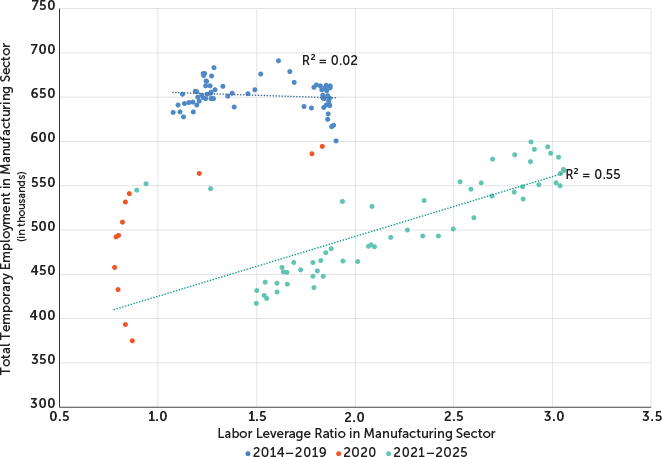
For example, manufacturing staffing jobs were not very closely aligned at all with changes in labor leverage in the prepandemic period (measured from 2014–2019). Only in the recent postpandemic era has a positive relationship been detected, where a little over half of the variance (R2 = 0.55) in manufacturing staffing can be explained by fluctuations in labor leverage from 2021–2025.
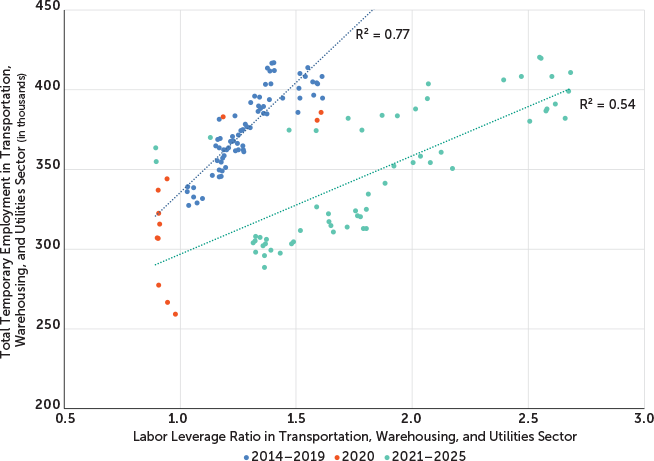
Transportation and warehousing also currently has the same strength of correlation (R2 = 0.54), but on the flip side the relationship was curiously stronger prepandemic (R2 = 0.77).
Together, both the manufacturing and the transportation and warehousing sectors—which ASA classifies as industrials—make up the greatest proportion of the staffing industry employment-wise (54.6% as of December 2025), yet, despite their similarities, have different dynamics with labor leverage.
In the case of manufacturing, the development of a correlation between leverage and employment level is probably due to changes in the labor market and production methods. While overall employment was higher prepandemic, a tight job market and volatile supply chains reoriented the employment dynamics within this sector, in addition to becoming more capital-intensive and productivity-focused.
While staffing in the manufacturing sector was boosted and repositioned due to volatility, it appears staffing employment within transportation and warehousing had a stronger correlation during the more stable prepandemic period. Economic stability likely helped create a direct relationship between quits and the need for backfill, which staffing companies were happy to assist in placing. Postpandemic, however, quits increased in large part due to high burnout—not better bargaining power, which made the labor leverage ratio a bit of a noisier signal comparatively.
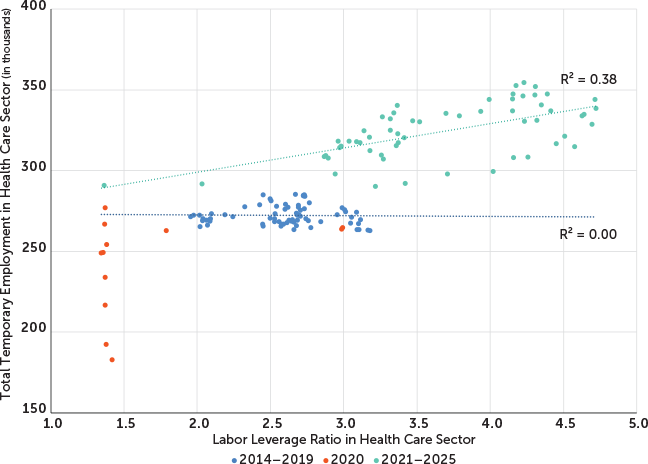
Health care is similar to manufacturing in that it also lacked a direct correlation in the prepandemic time, but high volatility and employee turnover has reshuffled the dynamics within that sector to make labor leverage an important indicator of staffing demand. Workers in health care have a very high leverage ratio that results in high turnover and the need for health care clients to utilize staffing services. While health care staffing has been doing the best compared to other sectors because of this, leverage has been easing—which has caused temporary employment to ease as well as cost-sensitive employers to look to other methods first to cope with vacancies.
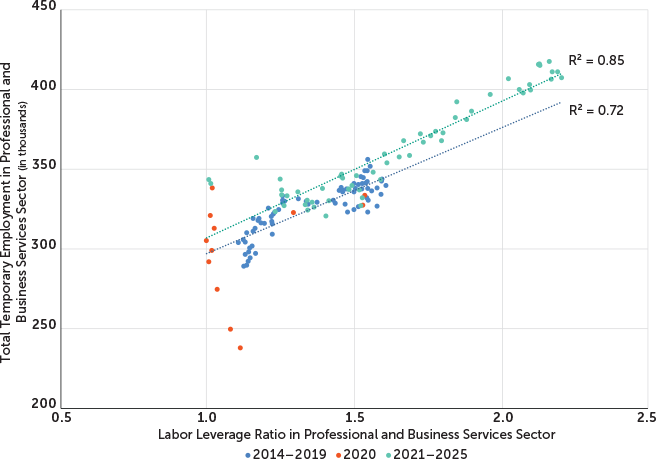
But a different sector has the strongest relationship with leverage. The professional and business services industry holds the position as the sector most sensitive to changes in labor leverage. The reasons for this are that workers in this sector on average tend to switch jobs more frequently and react more quickly to changes in wages and new opportunities. The more liquid nature of behavior explains why leverage is so important for professional services and why it has seen its staffing employment levels decrease in recent years (down by 19.5% from 2022–2025).
PUTTING LEVERAGE TO WORK
So, why should staffing firms care about these nuances between sectors? Because the dynamics ASA has seen within staffing sectors vary, it’s important to understand how an important variable like leverage impacts the sectors your firm services. Understanding where leverage is heading has a predictive power, regardless of whether or not leverage becomes less important due to normalization trends. The movement of labor leverage helps explain part of the spread between high-growth and underperforming firms within the staffing industry. If your firm wants to be a top performer, leverage is something to keep an eye on. Staffing firms can utilize labor leverage data to educate clients about the market conditions in their sector, helping the clients better understand pricing and one of the major determining factors behind it.
As we’ve noted, for several industries labor leverage only became an important indicator for staffing employment after the pandemic. For industries like health care or manufacturing, employers were pushed toward utilizing temporary services to address economic shocks stemming from the pandemic/postpandemic period. Volatility created urgency, which has since steadied in health care’s case or has dwindled even further due to economic factors in the case of manufacturing.
It’s possible that, as conditions continue to normalize, labor leverage will become a lesser factor in determining whether clients in sectors that lacked a direct correlation prepandemic bring on staffing talent in the future. A return to the prepandemic trend, however, is unlikely, as the gradual rising scarcity of workers reinforces the power of labor (especially in sectors that have always been sensitive to changes in leverage, such as professional services). This means, in the short term, that leverage will continue to struggle to increase due to economic conditions that are keeping quits low. In the long term, however, it will gradually rise in importance.
Leverage has helped determine industry leaders and laggards; it will likely do so again. In the meantime, while leverage remains on the downswing, staffing firms can position themselves as a low-risk option for employers to add headcount without committing to permanent hires.
PLANNING FOR THE NEXT UPSWING
If leverage is so important, where is it heading? While labor leverage has decreased across the board, it is unlikely to drop further as both the nonfarm quits rate and the nonfarm layoffs rate have stabilized at around 2.0% and 1.1%, respectively, throughout the last year. However, despite this stability, the severe lack of churn within the labor market has disproportionately brought down the staffing industry while the economy has continued to expand at a surprising pace (real gross domestic product grew by a historically high 4.4% in the third quarter of 2025). So, when can the industry expect a turnaround? When will leverage swing back toward staffing?
Despite current stable, if poor, conditions, labor is fundamentally scarcer now because the size of the workforce is gradually dwindling. The workforce participation rate is lower now (from 63.3% right before the pandemic down to 62.5% as of January 2026; it’s expected to erode even further to 61.4% by 2035), and as both overall job and population growth slows, this leaves employers competing for a gradually contracting pool of available labor—creating a longterm trend toward clients that are more reluctant to fire and workers who are more able to quit. That is, on paper, a winning combination for staffing, as it means the industry has its place matching talent to where it’s needed most. But it’s also important to note that, while this is an economy-wide trend, it will have sector-specific nuances.
Leverage has shown it can help explain why some staffing segments outperform while others have lagged, and it offers some predictive insight into where demand may be heading next. Firms that track leverage trends and understand their sector-specific implications will be better positioned to anticipate trends early, adapt their strategy, and ideally emerge as market leaders in the next phase of the ever-changing industry.
is an economic analyst at ASA. Send feedback on this article to s******@americanstaffing.net. Engage with ASA on social media—go to americanstaffing.net/social.