Even though layoff announcements are not fully translating to a rise in unemployment throughout the labor market, employees and job seekers still bear the brunt of risk in a stagnant labor market.
Noah Yosif

Even though layoff announcements are not fully translating to a rise in unemployment throughout the labor market, employees and job seekers still bear the brunt of risk in a stagnant labor market.
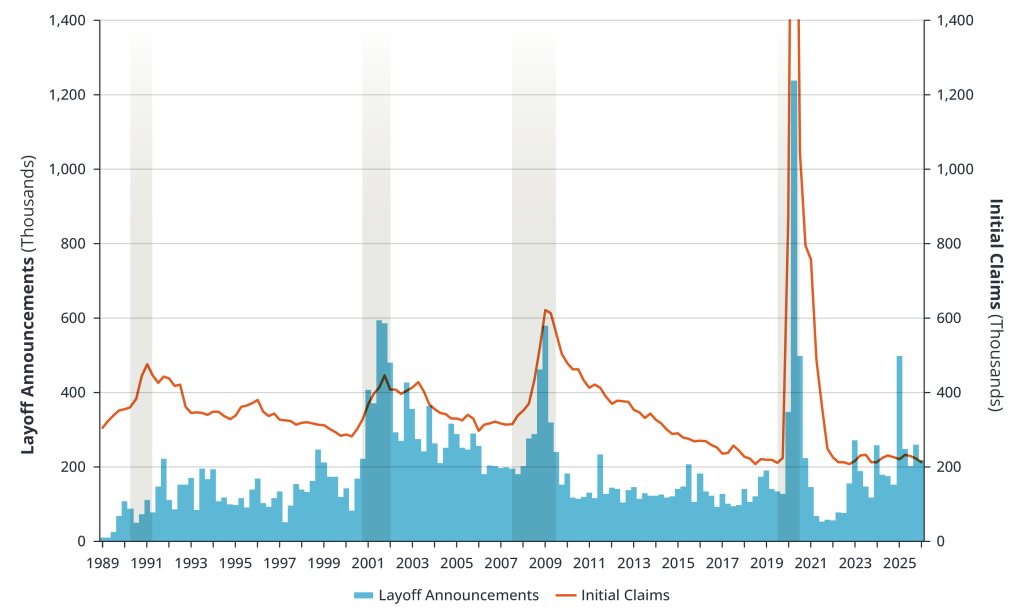
Despite today’s stagnant labor market, layoffs have been relatively low, which has allowed most workers to continue earning a paycheck and participate in the economy at large. However, it can be difficult to reconcile this fact when layoff announcements saturate the news headlines on a regular basis. Are current layoff announcements indicative of real weakness in the labor market? Or are they just an overreported signal? Since 1Q2022, the average annual number of workers expected to be laid off has risen by 274%. Meanwhile, the average annual number of workers seeking unemployment benefits—a relatively good indicator of unemployment—has declined by 51%.
Looking at the data, it is clear that layoff announcements are concentrated, and not indicative of further slack in the labor market. Excluding government, which has accounted for the majority of layoffs, retail and technology each has accounted for at least 10% of total layoff announcements between 2024 and 2026. These sectors collectively represent around 21% of the Fortune 500 and 28% of the Fortune 100, which suggests that layoffs at the largest firms might garner significant media attention, but they are not indicative of broader trends in the labor market.
Even though layoff announcements are not fully translating to a rise in unemployment throughout the labor market, employees and job seekers still bear the brunt of risk in a stagnant labor market. With employers still hesitant to create more jobs and expand headcount, employees are one layoff away from joining seven million job seekers already struggling to land their next opportunity. Therefore, while the labor market is still stable, it cannot remain stagnant in the long term without excluding more people.

With expertise placing talent, staffing firms can help new graduates start getting valuable experience that can translate to longer term roles and continue building their professional networks as they embark on their careers.
New and rising college graduates are contending with a more competitive job market in 2026. Job openings overall have fallen steadily over the last several years according to the U.S. Bureau of Labor Statistics, as available jobs dropped 30% from February 2023 to February 2026. Over a similar span, the ZipRecruiter 2026 Graduate Report shows entry level jobs have been declining steadily as a share of overall jobs, falling from 43% in March 2023 to 39% in March 2026.
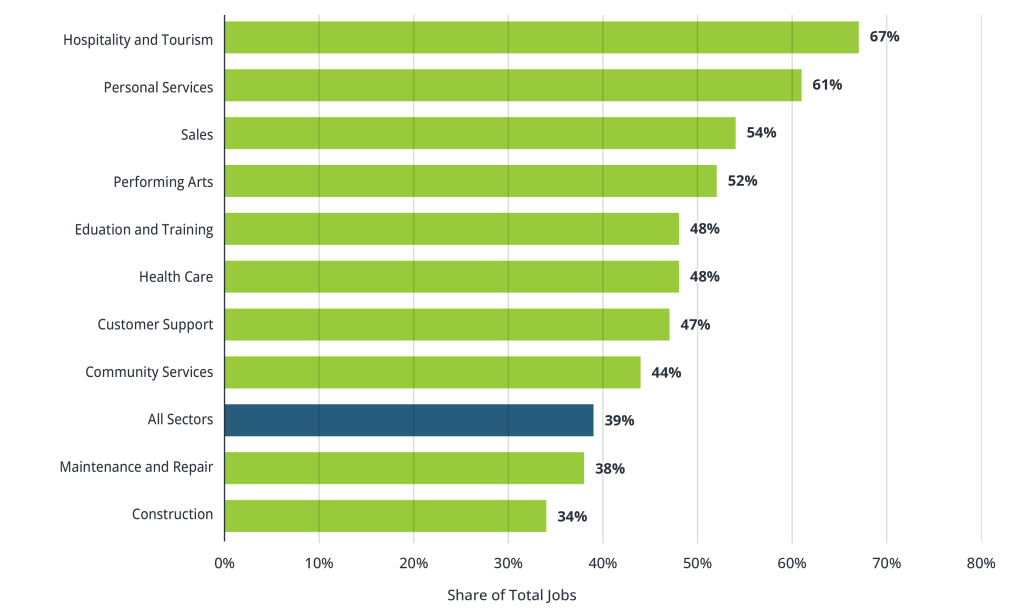
Some sectors are seeing a greater share of entry-level job postings than others. A majority of postings for hospitality and tourism, personal services, sales, and performance arts roles were for entry-level positions. Also, health care, education and training, customer support, and community services all boasted proportions of entry-level roles that were above the average of 39%.
For students looking to stand out, experience and networking are important. Students who worked in any capacity during college were twice as likely to have a job after graduation (82%) than those who did not (41%), though the former group was also more likely to start a job search earlier. Experience prior to graduation helped graduates feel qualified for roles they applied to and can signal work-readiness to employers. At the same time, most recent grads who are employed credit networking with landing their first job.
In a tough market, many graduates are turning to flexibility to find work. Given the challenging job market, three quarters of new graduates (73%) would consider alternatives to traditional roles including starting their own business (38%), taking on gig work (33%), delving into freelance work (28%), or entering a skilled trade (11%).
There may be some glimmers of hope for new graduates, as a new survey from the National Association of Colleges and Employers found that employers expect to increase new graduate hires 5.6% this spring compared with last year. In addition, the Wall Street Journal has reported that unemployment among bachelor’s degree holders aged 20 to 24 fell from 6.7% in March 2025 to 5.3% in March 2026, according to research by Bank of America Global Research.
With expertise placing talent, staffing firms can help new graduates start getting valuable experience that can translate to longer term roles and continue building their professional networks as they embark on their careers. As some employers signal stronger intentions of hiring this spring, the staffing industry has a lot to offer new graduates.