Manufacturers who lean strategically into engaging staffing talent will have an edge over their competitors by being able to deliver better results for their customers while only paying for as much labor as they need.
Max Aldrich

Manufacturers who lean strategically into engaging staffing talent will have an edge over their competitors by being able to deliver better results for their customers while only paying for as much labor as they need.
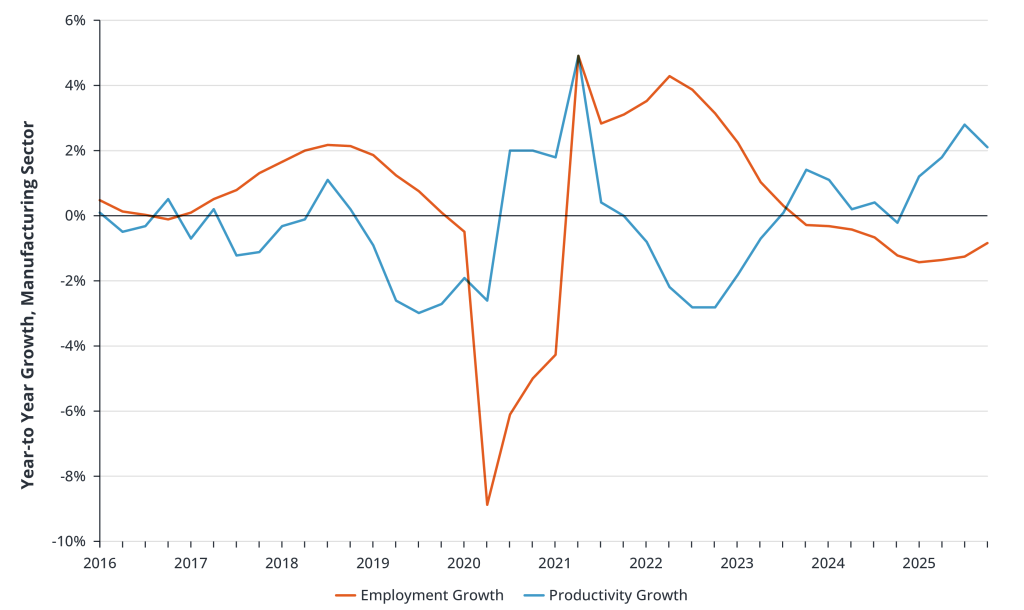
Industrial staffing makes up the largest proportion of employment in the industry, but it is currently caught in an ongoing divergence between rising output and lax labor demand. Manufacturing employment in 1Q2026 was down 0.7% compared to 1Q2025, according to the Bureau of Labor Statistics. While employment decreased at an average rate of 1.2% per quarter in 2025, productivity as measured by output per worker hour has grown at an average rate of 2.0%.
Last year’s trend is continuing into 2026, with the S&P Global U.S. Manufacturing Index noting a “worrying lack in hiring” as employers seek to minimize labor costs to offset rising input costs. The volatility from the conflict in the Middle East—and, before that, tariff pressure—has led to a rise in energy and material costs. While factories are experiencing an uptick in demand (as of March, industrial production has risen for eight straight months according to S&P Global), clients are still hesitant to translate that into increased headcount, choosing to accept slower delivery durations rather than hiring to meet demand.
Although this may seem like industrial clients are locking out staffing, there is a way for staffing firms to get a piece of the pie. Clients must be convinced that utilizing temporary labor is the best way to maximize the gains from an uptick in orders while at the same time tempering the permanent labor costs they want to minimize. Much like during 2025 during the tariff rollout, private companies are looking to build up their stockpiles again in response to economic uncertainty and anticipated future costs. Manufacturers who lean strategically into engaging staffing talent will have an edge over their competitors by being able to deliver better results for their customers while only paying for as much labor as they need.

As human resource leaders are still feeling out a changing economy, temporary and contract workers can offer a low-risk way for employers to meet their labor needs and support growth.
Hiring outlook among chief human resource officers has improved since the fourth quarter, according to The Conference Board. The latest survey of U.S. CHROs saw the CHRO Confidence Index rise to 59 in the first quarter of 2026, marking the highest reading yet since the metric was first introduced in the first quarter of 2023.
Of the three components of the index—hiring, engagement, and retention—hiring was the strongest, improving to 63 in Q1 after hitting 60 in Q4 2025. Nearly six in 10 CHROs (59%) expect to increase hiring in the next six months, up from 54% in Q4 2025. A mere 17% expect to decrease hiring over that span, though that number edged up from 15% in Q4.
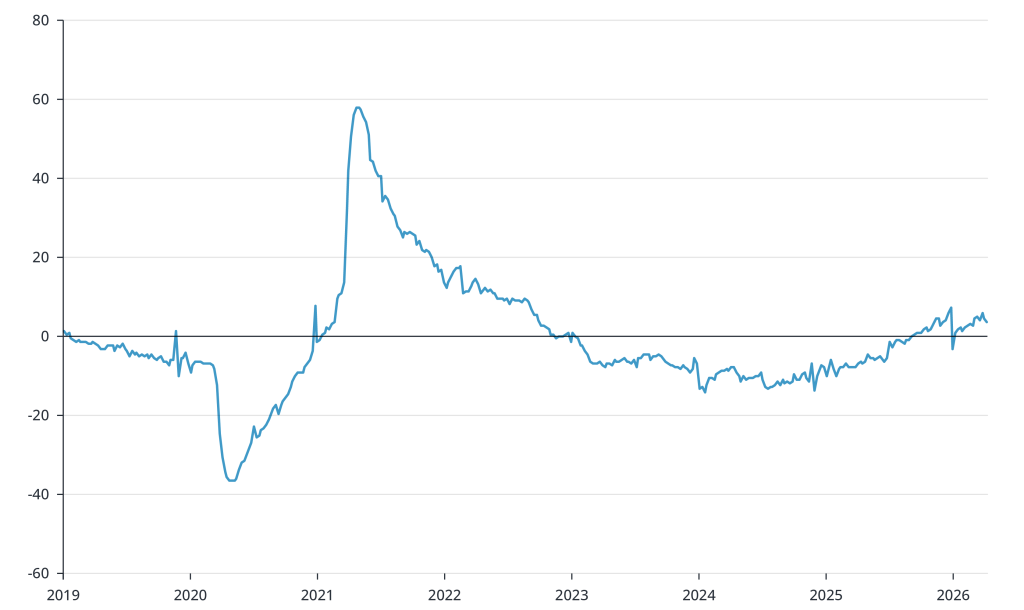
Improving hiring sentiment is an encouraging sign for a staffing industry that has been mired in an anemic labor market over the last several years, and this change in outlook may already be showing up in industry data. The ASA Staffing Index, which tracks weekly change in temporary and contract workers, has consistently reflected year-to-year growth in staffing employment since September 2025.
At the same time, the weakest component of the CHRO Confidence Index was retention. Despite edging up from 53 to 55 in Q1, only one in three CHROs expect their employee retention to increase over the next six months, compared with 19% who expect it to decrease. A separate study among hiring managers conducted by Express Employment Professionals found that hiring managers were expecting turnover of 50% in 2026, compared to 39% in late 2024.
While employers have been hesitant to hire and job seekers have been staying put, staffing companies stand to benefit if these trends reverse in 2026. As human resource leaders are still feeling out a changing economy, temporary and contract workers can offer a low-risk way for employers to meet their labor needs and support growth. By the same token, staffing companies have an opportunity to help fill roles quickly during times of lower employee retention.