The week of May 15, 2026

Weekly Economic & Business Outlook

Latest Economic Outlook
  • Recent growth in staffing demand has been driven by easing labor costs, allowing employers to add temporary workers without making long-term hiring commitments.
  • The recovery may be fragile, as rising inflation—particularly from higher food and energy prices tied to geopolitical tensions—could push labor costs higher again.
  • If labor costs increase, employers may scale back even temporary hiring plans, forcing staffing firms to navigate a volatile and uneven recovery environment.
Latest Staffing Research
  • Workers 50 and older perceive age discrimination as a barrier to getting hired, with evidence that at least some employers may look at age negatively.
  • Employer loyalty, deep experience, and broad professional networks are benefits workers 50+ can bring to employers.
  • Older workers have been leaning into training in disruptive technologies, and are closing the tech skills acquisition gap with younger worker.

Weekly Economic Outlook

05/15/2026

Should labor costs trend upward again, employers may be forced to pull back on plans for even short-term headcount like temporary workers. This means that the recovery of staffing employment is likely to be a bumpy one due to inflationary disruptions like elevated geopolitical tensions.

Noah Yosif

Danger! ¡Peligro! Gefhar! High Costs Ahead!

The recent rebound in staffing demand owes to months of progress on lower labor costs. While labor costs are high enough to limit growth across the labor market at large, they have meaningfully receded to a point where employers have the capacity to onboard some workers. At this point, hiring temporary workers is a preferable option because they can be brought aboard for a fixed period of time, allowing the employer to fill critical gaps without making long-term personnel commitments.

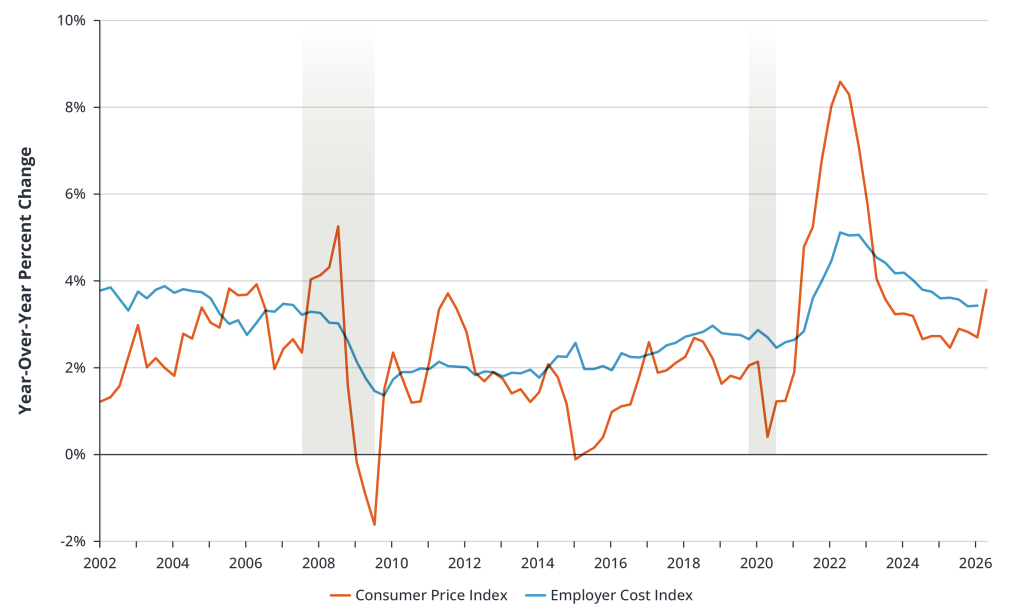
However, the downward trajectory of labor costs, as well as the consequent gains in temporary help services, could be short-lived. Tuesday’s Consumer Price Index report revealed a second major spike in inflation largely due to higher food and energy prices as a result of the conflict in Iran. Should the Strait of Hormuz remain closed indefinitely, higher labor costs are likely to follow as employers have to pay their employees more to maintain their cost of living. That is why labor costs usually tend to follow movements in CPI inflation.

Should labor costs trend upward again, employers may be forced to pull back on plans for even short-term headcount like temporary workers. This means that the recovery of staffing employment is likely to be a bumpy one due to inflationary disruptions like elevated geopolitical tensions. Staffing firms, having navigated this landscape for the past three years, will have to remain vigilant about acquiring new sales and demonstrating their value to clients while the labor market weathers this latest challenge.


Consumer Price Index vs. Employment Cost Index

Consumer Price Index vs. Employment Cost Index
Source: U.S. Bureau of Labor Statistics

Weekly Staffing Research Outlook

05/15/2026

With nine in 10 HR professionals reporting their organizations have no formal or informal recruitment programs targeting older workers according to SHRM, there is an opportunity for staffing companies to bring expertise in this domain to clients.

Tim Hulley

The Multigenerational Workforce Advantage

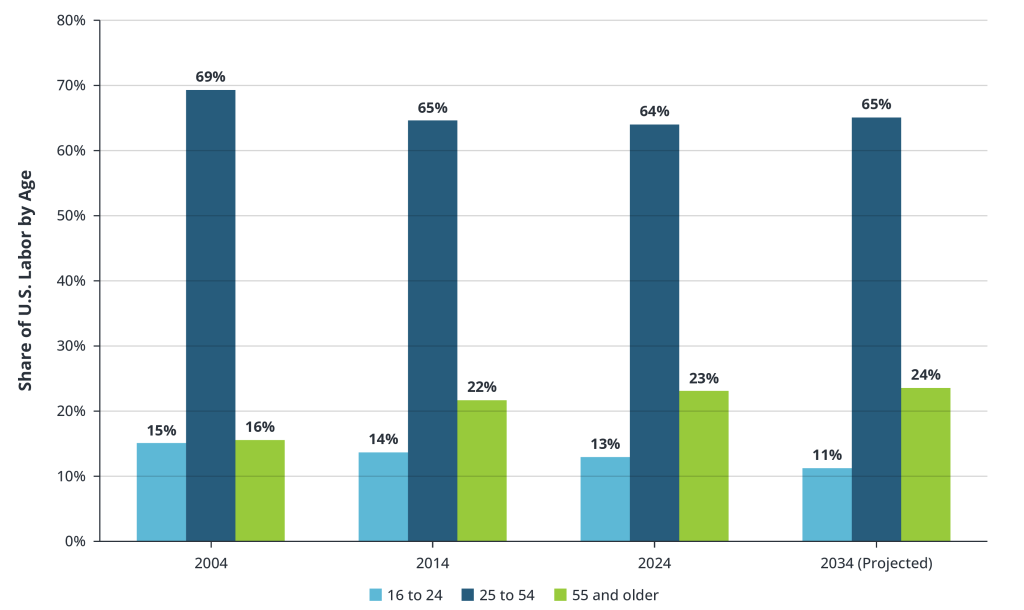
Despite anemic hiring demand, the U.S. unemployment rate is still relatively low, historically-speaking. This underscores the fact that in the long term, job growth may well be constrained by the availability of workers for open roles. One important driver of this trend is that the U.S. population, and by extension its workforce, is getting older. Nearly one-quarter of the labor force (23.1%) was 55 years of age or older in 2024, up from 15.6% in 2004. As the workforce evolves, employers must ensure all talent pools are open to them.

One barrier to employment for older workers is age discrimination. In a survey of employers by the Transamerica Institute, when asked about the age at which a worker would be too old to hire a majority said “it depends on the person” (56%) and handful were unsure (9%), but of the remainder that did provide an age, the median was 58 years old. According to a 2025 survey of U.S. adults aged 50 or higher by AARP, two-thirds feel it would be difficult to find a new job if they were looking for one today, and of those two thirds, 35% (the largest category) believe age discrimination would be the main factor causing difficulty in their job search.

Despite bias among at least some employers against older hires, a multigenerational workforce offers key benefits to employers. A study by LinkedIn and AARP found that workers aged 50 or older bring several key advantages to employers

  • Retention among older workers was higher, with 85.4% of those hired in June 2024 still with their employers at the time of the study, compared to 70.6% of younger workers
  • Deeper experience, with an average of 15 more years of work experience and 10 more years in leadership roles than younger colleagues
  • Professional networks on LinkedIn were 20% larger and contained more senior roles

At the same time, older workers have been increasingly investing in disruptive tech skill training as they seek to adapt to AI in the workplace. Data from LinkedIn Learning revealed that the gap between younger and older workers engaging in tech training narrowed from 31.1% in 2022 to 10.7% in 2025.

As the labor force continues to age and workers stay in the workforce longer, companies that optimize for multigenerational staff will be in the best position to compete for talent. With nine in 10 HR professionals reporting their organizations have no formal or informal recruitment programs targeting older workers according to SHRM, there is an opportunity for staffing companies to bring expertise in this domain to clients.


Share of U.S. Labor by Age

Share of U.S. Labor by Age
Source: U.S. Bureau of Labor Statistics

Economic Calendar

Real Time Economic Calendar provided by Investing.com.
Past Issues
Loading Issue...
Meet the Research Team
  • Noah Yosif
  • Tim Hulley
  • Max Aldrich
    Max Aldrich