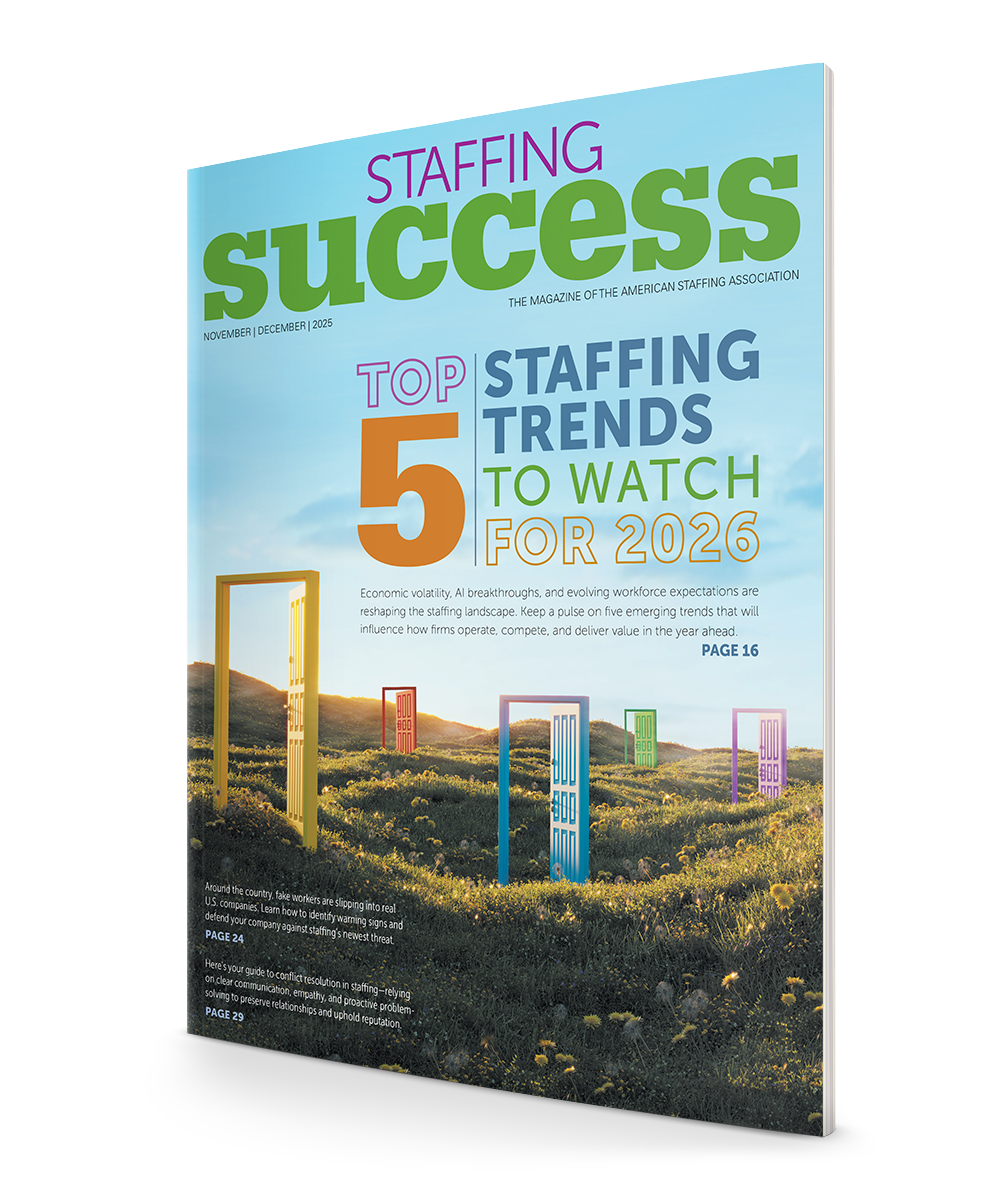
As 2026 comes into focus, the staffing industry stands at a crossroads of disruption and possibility. Economic uncertainty, AI innovation, and a changing workforce are reshaping how companies hire and how talent works. With insights from leading experts, ASA spotlights five key trends that will define the year ahead—revealing where challenges lie, where opportunity awaits, and how staffing firms can stay ahead of the curve.
TREND 1: CAUTIOUS COMMITMENTS: Hiring Fluctuations Amid Economic Uncertainty
Recent data from the U.S. Bureau of Labor Statistics indicates that the U.S. job market is slowing down, with job growth weakening and the unemployment rate at 4.3% as of August 2025. While some regions continue to show resilience, the overall trend suggests a labor market that’s “cooling from the exceptionally tight conditions of recent years.”
Uncertainty in the economy is driven by many factors, including inflation, rising interest rates, geopolitical risk, supply-chain disruptions, recession concerns, and even technological advances. As a result, many companies are hesitant to hire right now—especially for longer-term positions. However, opportunity is present.
“Staffing companies have always thrived in uncertainty,” says Ron Hetrick, senior labor economist and director of product for staffing at labor market intelligence company Lightcast. He also notes that he’d be hesitant to report to his board of directors plans to increase permanent hiring without a clear picture of where the market is heading, and would—like others—opt to bring on temporary staff.
“We saw that disappear in recent years,” he continues, “because with such a dearth in labor supply, companies were very hesitant—even if they were uncertain—to let people go. But the reality is we’re still buying things, we’re still moving goods, and our unemployment rate’s still low.”
The employment rate naturally impacts the staffing industry. “What was interesting was when unemployment got historically low, around 2019, and then in ’21 and ’22 it really struggled,” says Hetrick, explaining that while there were openings, finding people to fill them was difficult. “It was never really about people being desperate for workers; it was, ‘Why did they use staffing in the first place?’” For decades, the likely answer to that question was that staffing firms play the role of client middleman. “You’re going to save me time and money by taking care of this for me,” says Hetrick, from the viewpoint of the client.
ASA chief economist Noah Yosif agrees. “If you think about the staffing industry as a matchmaker of sorts, we thrive on hiring when employers are seeking workers, and workers are seeking new opportunities,” he says. “Going back maybe three or four years, during the Great Resignation, we saw a lot of movement in the labor market—and that’s why orders were ringing off the phone, because employers needed workers and workers were looking for their next new opportunity,” he continues. “But, as labor costs rose due to inflation and interest rates, employers started to pull back on their appetites for bringing on additional headcount—and once you had that appetite dry up, that led to declines within staffing employment. We started to see companies not only pull back on their hiring but also correct for the over-hiring that they did during that period.”
However, according to Yosif, a shift is happening. “We are beginning to see an increase in staffing employment,” he says, noting that the ASA Weekly Staffing Index had risen for the sixth consecutive week, as of the end of October. “What we’re seeing right now is that companies are hesitant to make long-term investments in headcounts—bringing on, for instance, more full-time and part-time workers—but they are willing to bring on temporary workers for a short amount of time, so that way they can test the waters and see if they really want to make those longer-term investments in headcount.”
Turning Uncertainty Into Advantage
Recent research from Robert Half echoes the fact that employers are focusing less on expanding headcount and are more concerned with securing targeted expertise to advance important initiatives. This presents an opportunity for firms to step up and differentiate themselves. “In a time where clients are going to be hesitant to hire, it always helps to be a specialist rather than a generalist—and to focus on how you can provide specific value to a client at a given point in time,” says Yosif.
Companies will begin to look at longer-term commitments as things ultimately shift yet again. That said, firms must keep up with trends and not settle for business as usual if they want to remain competitive.
“As clients are beginning to think about adding additional headcount, it’s going to be important for staffing companies to keep at least one finger on the pulse of where some of these broader labor market trends are going,” says Yosif. “For example, there’s this huge AI disruption that’s primarily targeting white-collar workers. Whether we like it or not, a lot of companies are still in a mindset of ‘I need to invest more in AI, which means that I’m going to be putting labor on the back burner.’ Therefore, what staffing companies can do now is focus on how their talent benches are able to address the needs that clients are going to have in the future.”
In other words, firms can consider investing in ways to make their talent (and in turn their firms) stand out—differentiating themselves as competition rises by making sure the talent they present have the skills clients are looking for, in addition to providing offerings like labor market insights and flexibility within their services and solutions.
Insight as an Edge
What do those solutions look like—especially in an uncertain environment impacted by everything from tariffs to geopolitical events to AI? According to Hetrick, it all starts with being in-the-know and paying attention. “Once you know the factors that are affecting clients, that’s the data—that’s the news stories, that’s the stuff that you start to actively feed in, because the second these things turn is when you call [the client],” he says. Cautioning against being insensitive to these factors, Hetrick stresses reaching out with empathy—demonstrating that you understand the client’s challenges and can offer information to address the challenges that they may not be privy to.
Using data that he’s collected related to labor provided via immigration solutions and associated shifts as an example, Hetrick explains that some clients will not fully understand the impact of losing employees. “That’s a great marketing tool, to go to a client and say ‘You have professional roles; I understand that you are probably getting spammed so badly for these. Let me show you what we’ve done for other clients that take care of all of that for you.’’’
Another example Hetrick gives involves recruiters receiving “fake” applications, clogging their systems and making it necessary to train internal systems (people improving the technology) to weed them out. He highlights this as an opportunity for firms to use this type of data to demonstrate how they can bring value in new ways, as a direct result of one of the main disrupters affecting the industry.
Define Your Difference
“Be specific and focus on one area, because companies are going to be inundated with folks claiming to be the one-stop-shop solution to all their problems,” advises Yosif. Companies realize they have options in staffing, including access to job boards like Indeed and Upwork and the ability to deploy their own AI programs in-house. “Staffing companies are seeing a lot more competition on the solution side, and they’re going to need to work much harder to be able to develop that value for clients,” says Yosif.
When it comes to AI, Hetrick believes that concerns about technology replacing humans is overhyped—emphasizing that most AI applications are query tools rather than true automation, which still require humans. That said, staffing companies can support clients through upskilling their workforce in areas related to AI, but perhaps more importantly as it relates to improving the thinking skills companies are seeking.
“What most folks are looking for right now in candidates when it comes to skills are those that have cognitive abilities and almost higher-order levels of thinking relative to where technology is right now,” says Yosif, admitting that although AI’s reputation and the fear it’s causing may be overblown, the technology can act as a “glorified research assistant.” “That is augmenting the level that the next generation of workers needs to supersede in order to be attractive to employers. Staffing companies need to figure out how this next generation of workers can complement what is already out there, AI or otherwise.”
TREND 2: BALANCING ACT: AI’s Dual Impact on Labor Demand
AI is transforming how talent is sourced and evaluated, as well as the type of roles that need to be filled and how people are filling them. While it is not likely to eliminate all jobs, it is already transforming many of them. For example, routine industrial work, retail, clerical, and office support roles, as well as those centered on customer service; are likely to see change or disruption—while more tech-heavy sectors are likely to experience opportunities because of AI’s continued growth and utilization. That said, a recent Forbes article stated that AI competencies extend beyond tech roles into virtually every field, noting the need for finance professionals to possess AI analysis skills, those in marketing to hold prompt engineering abilities, and HR specialists to have an understanding of AI-driven recruiting tools.
“Staffing firms absolutely need to look for ways to adopt AI in their operations. It is mission-critical moving forward for staffing firms to embrace it,” says Jason Leverant, CSP, president and chief operating officer of AtWork Group. Acknowledging the argument that staffing is very much a “humancentric and relationship-driven business,” Leverant cautions that the industry must be forward-looking.
“In order for us to be competitive in the future—competitive not only with our peers in the industry but with what our customers have access to from the standpoint of a resource set—we have to be faster. We have to be more accurate, and we have to be able to engage with a larger volume of candidates and clients in a more rapid way,” he continues, noting associated challenges. “You don’t want to take away from that human aspect of it, but you’ve got to give the human the tools to be able to keep up with the competition.”
Keeping up doesn’t mean sacrificing on quality or the activities needed to build those relationships with clients and talent. “Those components are going to stay absolutely and squarely on the human side, but in order to do that we need to have the same tools as our peers and better tools, hopefully, than what our clients have access to,” says Leverant.
Supporting his assertion, StaffingHub’s 2025 State of Staffing Report found that “fast growth” agencies differentiate themselves through technology adoption, finding that AI adoption has surged to 61% of agencies (up from 48% in 2024), with conversational AI (55%) and résumé parsing/database cleanup (45%) being the most common applications.
Noting that companies of all sizes have access to what he refers to as traditional generative AI products (products where you can ask a question and have it generate text or content), Leverant emphasizes how these basic, readily available tools can help firms build strategy and more, often with a limited, low-cost, paid subscription.
“It is absolutely vital for staffing salespeople and recruiters to help clients level up their game with the right prompting, and that’s where there’s education required for the user. Those types of tools can be extremely powerful and help that salesperson go and engage doing the human things,” he says.
Leverant advises firms to embrace AI, stay informed about industry trends, and engage with peers and vendors to position themselves as strategic partners in the evolving job market. He also believes firms should be partners with the communities where they are located and the people who are seeking employment, beyond simply placing them with a client.
“I’ve always kind of taken this approach to the industry, that when we open a branch in a community it’s our goal to make an impact in that community by helping people find jobs—regardless if it’s through us or not.”
TREND 3: GROWING COMPETITIVE PRESSURES: Conveying the Industry’s Value Proposition
Clients are consolidating their staffing providers, and in some cases developing their own internal platforms and programs to recruit and train existing staff to fill needed employment and capability gaps. As a result, staffing firms are finding themselves answering the “Why Staffing” question more often as clients demand more; competition is up; and revenue is, in many cases, down. “Revenue for our industry is down, penetration rates have decreased, and demand is down for our services in many sectors,” says Jeff Harris, who sits on the board of IT consulting and staffing company Tential.
While AI and technology are factors, Harris believes that demand is more directly impacted, again, by uncertainty—offering that people are perhaps weary of what’s going to happen with the economy and what’s to come because of increased AI utilization. “It’s really the idea that AI’s coming, but we still don’t really understand it’s utilization or ROI, that is causing a lot of paralysis and uncertainty from buyers—and even executives—to hold back hiring and project spending,” he explains. Couple that with a low worker turnover rate, and it’s not great for the industry.
Rewriting the ‘Why Staffing’ Story
“It’s a great question to ask what has changed in the value proposition due to recent trends, and what’s remained constant,” says Harris. “We need to up our game and educate our customers on what technology, AI, and economic trends we’re seeing and how they can take advantage and optimize their workforce, and get our customers comfortable buying from us.” That said, Harris doesn’t believe the value proposition for staffing firms has fundamentally changed much, as customers have been increasingly wanting “talent as a solution—not as a transaction.”
He also asserts that organizations that can engage in conversations about the customer’s business and offer clients upfront solutions for things such as building a project team, sourcing the right talent, or providing specialized talent to solve a business challenge, for example, will do best in today’s environment. “The market share and margins for transactional and broad-based staffing have been eroding for years—this is not a recent trend,” says Harris. “For companies that just want to be transactional and fill orders, the market share that’s available is becoming less and less. If you can’t articulate a talent solution, you may be asking ‘Why do my customers not see our value like they used to?’”
Better articulating the industry’s value message for things such as the access staffing firms have to the entire U.S. workforce, as well as the ways in which they solve client workforce issues outside of simply filling a vacant role, is critical to preserving the industry.
“Our industry, in general, needs to do a better job at articulating to our customers that we are not just a staffing industry,” says Harris. “We have a larger virtual bench of talent than any other industry, in my opinion. We build project teams; we deliver solutions; we work on mission-critical matters daily. If we’re just viewed as an industry that fills jobs, it weakens our perception and we risk our clients thinking we can be automated.”
Thus, companies that choose to stay firmly in the staffing nomenclature are less likely to thrive moving forward. “A lot of those companies are probably going to go away in the next decade and not be able to survive, because if there is a place where our customers will believe technology and AI can replace us, it’s in that very transactional aspect of the business,” explains Harris.
Part of providing solutions is being an advisor to customers. Many of them aren’t aware of how difficult the war for talent really is, and what it takes for a staffing firm to deliver its services. And according to Harris, there’s more value in leveraging one great firm over competing firms. “I think there will continue to be a growing trend for customers to use one provider instead of multiple providers,” he says, noting that those that choose to deepen existing client relationships and know how to differentiate their offerings are setting all parties up for more exclusive partnerships.
When it comes to the “Why staffing?” question, Harris flips it: “To me, it’s why do you think we’re just staffing? We can do a lot more than that.”
TREND 4: SKILLS OVER SCHOOL: The Rise of Competency-Based Hiring
In recent years, a shift in the qualifications employers are seeking when it comes to potential new hires has been observed. While traditionally formal degrees have been the golden standard, today more employers are emphasizing the need to bring on talent who possess practical skills, certifications, demonstrated ability, and strong work history, as well as the potential to learn. In fact, Intelligent.com reported that as of 2024, 45% of companies surveyed the previous year planned to eliminate the degree requirement altogether. When did this shift begin to become more apparent? According to Kelly McCreight, CSP, chief executive officer of Hamilton-Ryker, it began with Covid.
“Before Covid, most of our clients required a degree, a high school diploma, or a GED,” says McCreight. “Once that happened, almost all our clients dropped that requirement. They’re just looking for people who have a good work ethic and are willing to train on the job, where maybe they weren’t before.” He gives an example from his industry involving forklift positions. “In the past a client—especially, say, a Fortune 100 customer—would want prior forklift experience, or a prior certification. That same client now, if you’ve got experience using hand tools, they’re more than willing to train you how to drive a forklift.”
What’s Driving the Skills Revolution
“The stark reality is that there aren’t enough workers to replace the ones leaving the workforce,” says Cathi Canfield, vice president of associate experience and advancement at Employbridge. “Then you add a turnover number to that; it’s just very hard to staff your company.” Adding to the equation the uncertainty around immigration, she acknowledges the difficulties clients face trying to stay on top of headcount. In turn, they’ve had to find ways to be creative and be more willing to train existing talent. In that vein, Canfield discusses the emergence of “gigs.”
The gig economy is defined as “a labor market characterized by the prevalence of short-term contracts or freelance work as opposed to a permanent job.” This shift represents a clear opportunity for staffing firms.
“We have a lot of workers who are interested in being more independent. They like the entrepreneurial aspect of a gig opportunity; they like the flexibility of that schedule,” says Canfield. “The concept of ‘I need to work 35 or 40 hours a week, at a set schedule, doing one thing’—especially for that younger workforce—it’s just not as attractive as it once was.” Therefore, her firm prioritizes educating its clients on the opportunities present if they lean into this concept and the thought behind it.
“As we work with larger employers, we’re really challenging and encouraging them to think about some of their jobs in a gig format to make it more interesting to a younger worker,” she says. “And if we can train that person in a gig segment—we think about gig as four hours or less; what is a trainable skill that someone can learn in four hours or less—we are onto something. We can really compete in that gig space.”
Whether a long- or short-term “gig,” new assignments often require new skills, and employers are looking for specific skillsets, while talent is equally concerned with expanding their own.
Several staffing and employment-related studies mention the growing need to close a skills gap. The World Economic Forum’s recent “Future of Jobs” report found that while global job numbers are expected to grow by 2030, nearly 39% of core job skills will also transform—with existing and emerging skills differences between growing and declining roles potentially exacerbating existing gaps.
While required skills for talent vary by industry, these reports indicate that across industries, the job market is shifting toward skill-based hiring. Though technology-related skills remain important, the Future of Jobs report also found that creative thinking, resilience, leadership, and even environmental stewardship are becoming just as important to employers, highlighting the value now placed on well-rounded talent.
The demand for evolving skills and the need to upskill and reskill the current workforce will remain significant for some time. Therefore, staffing firms should consider partnering with clients on, or developing their own, upskilling and reskilling services, apprenticeships, and certifications—and perhaps lean into alternative ways to recruit talent.
When asked about trends related to nontraditional ways to find talent and supplement the workforce, Mc-Creight suggests going back to school. “You’re starting to see everyone going into high school to talk to students about all the opportunities that there are outside of college,” he says, noting that in addition to staffing firms tapping into this young talent pool, workforce boards and clients are doing so, as well. “Our clients are going and just grabbing these people right out of high school, no experience required.”
Another trend McCreight is focused on is secondchance programs. “We’ve got a division that is really focused on people that are incarcerated—putting together a formalized apprenticeship program for when they exit.” While not the solution for all staffing firms, the takeaway is that the current market will require firms to think outside the box and evolve.
“Companies like Amazon and Walmart, which are really competing in that hourly bucket, even go so far as to create upskilling, certification, or microdegree programs—even outside their industry,” explains Canfield. These practices encourage workers to stay longer, reducing turnover. Again, staffing firms should consider offering similar opportunities.
“What we know at Employbridge, based upon some insights work we do with our customers, is there is a huge lift for staffing companies who can say they offer upskilling and learning opportunities to their workers, versus staffing companies who don’t offer anything,” says Canfield. “Offering something is better than offering nothing; even if it’s small, get started on something. That gives you an immediate leg up.”
TREND 5: THE NEXT FISCAL BATTLEGROUND: States on the Legal Front Lines
“The Trump administration has moved in a direction of trying to cut a lot of funding and save money,” says Toby Malara, Esq., vice president of government relations at ASA. The cuts have been across various spectrums, and then there’s the “Big Beautiful Bill” signed in July.
Navigating the Tax Ripple Effect
“One of the biggest things about that bill was this talk of Medicare cuts—when that was going to go into effect, and how that was going to affect the states,” Malara notes. “States don’t have a lot of options when it comes to Medicare—they’re just going to have to figure out a way to fund these people and make sure they’re taken care of, and they’re going to need to find money somewhere.”
In other words, there will be taxes—and, according to Malara, they’re going to be passed along to businesses.
“We’re most concerned with a tax on services,” he says. “And we saw that earlier this year. There was a bill proposed in Maryland that authorized new taxes, and staffing was kept out of the bill, thanks to ASA and one of its member companies, Allegis. Then we saw a similar bill pass and signed into law in Washington state, which changed the tax scheme there. Now, services are taxed as retail, which just means they’re paying a much higher tax and their clients are paying a higher tax.”
Malara believes that as states look to fill budget holes and find revenue, taxes on businesses will pick up, and he questions at what point a tax on staffing will really start to hurt employment. “Now you’re causing employment problems: Less people are employed, and you get in this pattern of decreasing revenue to the state,” he says.
Outside of contributing to advocacy efforts, those within the staffing industry must stay informed and be willing to educate their clients on what’s going on.
“There’s a great story to be told here about staffing firms putting people to work, helping people find their careers—that’s really what our members and staffing firms do every day. What we don’t want is the tax to get in the way of that,” says Malara.
“From a staffing firm’s point of view, we always want them to be more than just a transactional partner with a client. We want them to have an actual partnership.” This includes proactively discussing matters like the possible tax with clients, before it shows up on a bill. “Go to the client and say ‘We’ve seen this in a couple of states; we’re concerned. There’s nothing now, but we’re going to make you aware of it,’” says Malara. “If you’ve got that type of relationship with your client, it’s going to be very, very helpful.”
He continues, “You’re always going to be emphasizing what you do, and how you can respond as a partner—that doesn’t go away. That’s still what a staffing firm prides itself on.”
is owner and chief creative officer of TiffaniWrites LLC. Send feedback on this article to s******@americanstaffing.net. Engage with ASA on social media—go to americanstaffing.net/social.