He can at times seem to have a gruff exterior—but it’s really just the native (and enthusiastic) Chicagoan coming through.
He can at times seem overly excited about business topics (he’s a frequent guest on financial TV shows)—but it’s really just decades of growth-focused leadership tackling the challenge at hand.
And over a professional lifetime in the staffing industry, he has earned a reputation for being a tough-love ambassador of company culture—one where there’s no place for excuses, business growth is always a top priority, and everyone must meet the same high standard.
Tom Gimbel founded LaSalle Network in Chicago in 1998. As chief executive officer, he led the company through astronomical growth while it racked up the accolades. LaSalle was named to the Inc. 5000 list of fastest-growing privately held companies for 11 consecutive years (and 12 times overall), making it the only Chicago-based company to do so. In a five-year span, between 2014 and 2018, LaSalle grew revenues by 83%. The company has achieved extraordinary growth primarily through organic geographical expansion.
Overall, LaSalle also has received more than 100 culture and revenue-based awards, including multiple mentions on Glassdoor’s Best Places to Work and Fortune magazine’s “Best Companies to Work for in Chicago.” So, when it comes to leading a successful staffing company, is it a gamble to focus more on growing your people than growing your business? Or should it be the other way around (especially when inevitable business disruptions emerge)?
The answer isn’t either/or. Rather, it’s a Gimbel.
Both are equally important and critical to success.
Both must achieve a symbiotic relationship that, if sufficiently developed, produces awardwinning results. Gimbel acheived this and more with LaSalle—but he still had more to give and contribute.
Having served on the ASA board of directors since 2015, he officially became board chair 10 years later at Staffing World®—where he passionately told his peers in attendance that taking on this leadership role is a pinnacle opportunity in his career, to give more and give back to the industry and to the association.
He has accomplished so much that he’s now the perfect sounding board for business ideas, growth strategies, and employee productivity tips. In January, Gimbel spent the day at ASA headquarters—just outside of Washington, DC—to meet with every department. It was a listening tour of sorts, combined with strategic conversations about challenges and goals.
To put it simply: ASA chair Tom Gimbel was in his element, thinking, analyzing, and strategizing about what’s next—which may be what sparks his success.
He’s never done—there’s always another win.
As the legendary Chicago Bears football coach Mike Ditka once said: “Losers quit when they’re tired. Winners quit when they’ve won.”
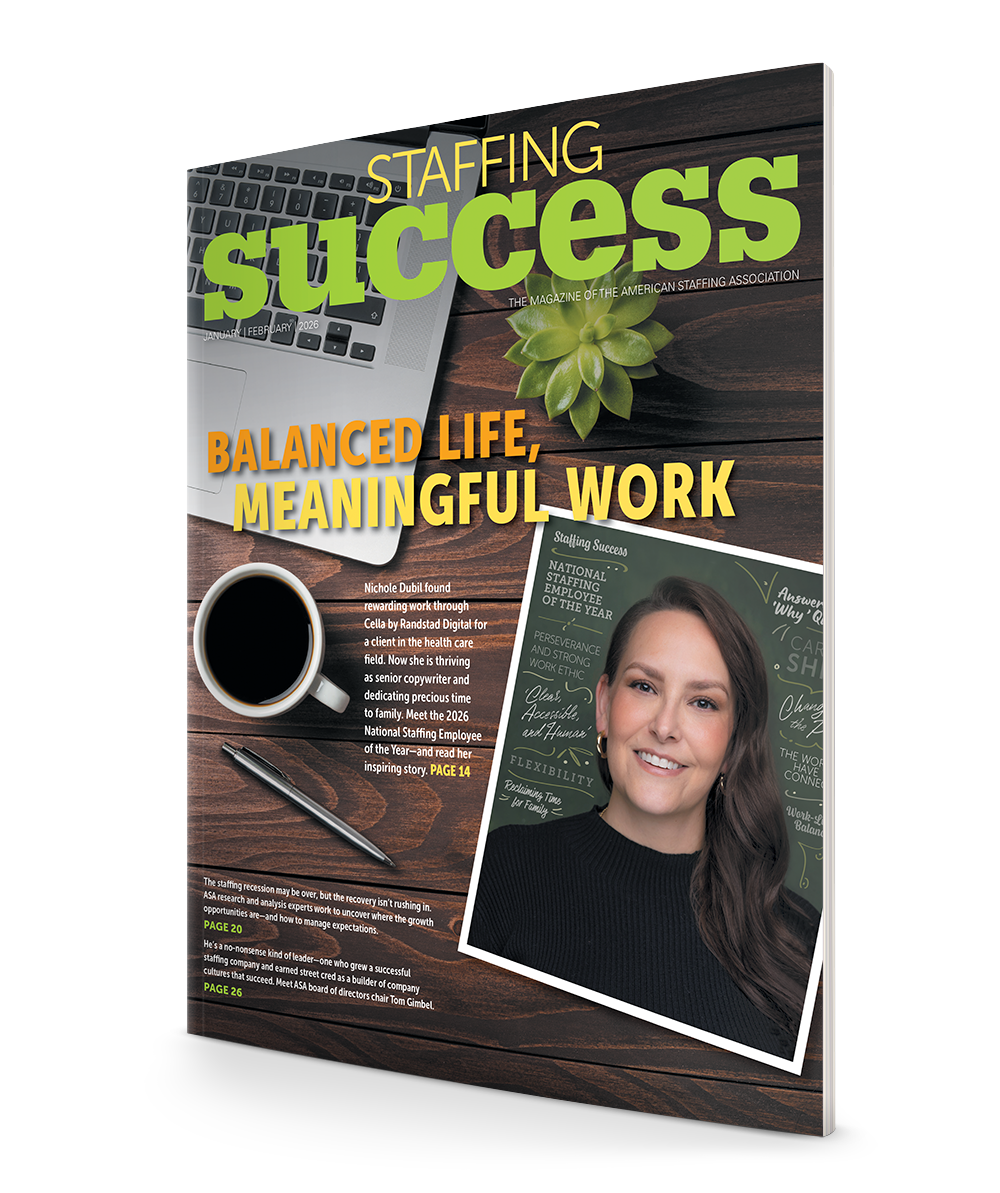
Staffing Success (which Gimbel says he “loves” to read) caught up with the ASA chair to pepper him with questions, particularly about his reputation for being a master of company culture and his well-established record for driving organic business growth. Here is just part of that interview—see the rest at americanstaffing.net/january-february-2026.
SS: There’s a lot to see when examining your staffing success as the founder of LaSalle Network, but there are two areas that consistently rise to the top: company culture and growth-focused leadership. Let’s start with culture. LaSalle consistently has been recognized as a great place to work, by Glassdoor and others. How do you achieve that kind of success and keep it going as the company grows?
Gimbel: The larger the company gets, the fewer people you’re directly managing, and the more you’re leading. There are some different dynamics at work, too, including different economies and different timetables. That said, I think that’s where a lot of staffing company owners get in trouble: When the company grows in size, they don’t evolve their style. Or they’re trying to lead when they’re very small, when they really need to be a manager. You have to get the pulse of your company.
But first and foremost, when you’re hiring people…well, I used to use the expression: Do what you’re told, and then go do what you think. If you work for somebody and they ask you to do something, you should do that. And when you finish that task or that goal, then you should be asking, “What else can I do?” From a culture perspective, you need people who are going to execute on what their directives are and contribute to everyone’s success. To me, that’s a really big culture thing. Then I believe that negativity is a cancer and positivity is a cure. I really do believe that if people aren’t happy to be working there, they shouldn’t be working there.
I’m not saying you can’t have a bad day. Everybody in the company is going to have two or three bad days a month. Out of 20 days, that’s 10%. Those three days are going to suck; 10% to 15% of the month is going to suck. So that means 85% to 90% of the time you should be really happy. I’m a big believer in that. No one grows up and says, “I want to be in staffing.” That’s usually not the case. But you can achieve that with how you manage people.
One of my favorite quotes comes from a Chicago guy, Mike Ditka, who said, “If you don’t have genuine enthusiasm, fake it.” I always laugh at that, but it’s true. You don’t want people who are “Stepford Wives” walking around with what you know is a fake grin, but you also don’t want people who are “woe is me” and “I don’t like it.” So, I really put an emphasis on people who can be happy in a situation.
SS: So, put the right people in the right jobs. Make expectations crystal clear. Manage when you’re supposed to manage, and lead when you’re supposed to lead. Tell us more about that last part. What are the differences? And how does that help you succeed as a growth-focused leader?
Gimbel: Management is literally day-to-day, minute-to-minute, hour-to-hour. Are you doing your job? What are your key performance indicators? What are your metrics? Did you get your tasks done? That’s management.
Leadership is creating a shared vision of where you want people to go and the behaviors they show in how they get there. You can have somebody who is an excellent task person, but not a good behavior person. That would be great management, but poor leadership. I really believe that there are people who have a unique ability to inspire. That’s No. 1 for a leader. No. 2 is very clear and consistent communication. And I would say that most people fail on that second one. They might say something clearly and then not say it again, so consistent communication is critical.
And then No. 3 is actually caring about the people. Most people don’t know how to say they care about somebody. All the young people now say, “I appreciate you.” When I was working [in the LaSalle office], I would say to my people, “What exactly do you appreciate about me?” It’s about the ability to convey that you really do care and that you really do understand and think about what’s important in people’s lives. For me, as a leader of people, I always wanted to find out what made them who they are. “Where did you grow up? What did your mom do? What did your dad do? Where are you in the birth order? Are you close with your siblings?”…The more people you have, the harder it is to do. But my feeling was always: I’m getting a coffee—whether it’s in the office kitchen or going to Starbucks—five days a week. I’m eating lunch, maybe with a client, five days a week. I’m going to dinner five days a week. I’m doing all these things during the weekdays—why not do them with somebody who works for me?
Listen, I’m not going to paint myself as perfect, but I did that more times than not, and I believe that a CEO’s role in a small company—maybe under 500 employees—is to walk around and talk to people and know what’s going on. It’s that presence that’s really important for people. I think that a lot of times leaders have either too high of an image of themselves or they don’t realize how high of an image others have of them. I’m a big believer in higher-level people talking with everyone and treating them with respect.
SS: What about when times get really tough—what are the conversations like then? How do inspiring leaders behave; what do they say or do when sales are down or there’s a global pandemic or the economy tanks? How must the conversations and the interactions change?
Gimbel: I’m probably a little weird in this regard, but, from a leadership perspective, I liked 2020. (I also liked 2008 and 2009.) The reason: I thought it was the great equalizer. And I’m not saying we were competing against them, but business leaders like Mark Zuckerberg or Jamie Dimon, companies like Allegis or Insight Global—nobody knew what to do. Who knew how to handle a global pandemic? Nobody. And if I have arrogance, then this is it, but I thought: I can be as right as they can be. What do people need? What do people want?
From March 16 until Memorial Day, we had a virtual town hall meeting every day. Some days it was telling jokes. Some days it was talking about a client. But every day for anywhere from five minutes to half an hour, we would have a town hall on Zoom. Everybody would be on; they had to be on. I said, “We’re not going to do this forever, but we’re going to do this until I say stop. If I can be here, then you can be here.” And if I saw someone during the meeting who looked upset or just not OK, I would ping my head of HR or I would ping their manager. .It was always about empathy; I’m a big believer in empathy.
SS: When you think specifically about growth-minded leaders, though, you don’t think about empathy—at least not at first. You think business, strategy, vision, execution, discipline. Why do you think that’s an integral trait for a successful leader to have—particularly in the staffing business?
Gimbel: How can you be good at delivering client services if you don’t have empathy for your clients? How can you be good at recruiting and retaining talent, if you don’t have empathy for candidates? That’s not just in staffing; that’s across the board.
But that’s also where I think most leaders fail—when their empathy for their clients, for example, overtakes their empathy for their people, their internal staff. If I were my employee, how would I want to be treated? Then you also have to explain to the employee: If you were your manager, how would you want you to behave?
As leaders, we really have to know what’s going on with our people. Why is your star performer not producing like before? Or why has their performance sort of plateaued? It’s easy to lack empathy and just look at the reports or the spreadsheets. But it should be more like: What is going on in their life that’s affecting them?
You want people who are positive, who are going to be upbeat at work—but we’re all human.
SS: How did your company not just survive economic dips or recessions, but actually have the ability to grow in tough times—such as in the years surrounding the Great Recession that began at the end of 2007?
Gimbel: If you’re a small or medium-sized company, even if the market isn’t growing, you can still take market share. You have to reframe things in a down economy—and it’s about market share. I think most people would say, “Oh my goodness, all of our clients are going to scale back by 30%.” OK, then go get more clients.
In 2008 and 2009, I said to my people: “We’re going to be working harder. We’re going to be working more. But we’re also going to be having more fun.” And we did. We grew in 2008. We grew in 2009. We grew in 2010. Together, we created our competitive advantage. Economic uncertainty, recessions, business disruptions—these are things we can’t always control. But we can control our behavior and how we respond.
SS: What would you say to a staffing firm owner who’s on the fence about becoming a member of ASA?
Gimbel: I would ask: “Do you like the industry? Are you happy with the industry? Are you committed to the industry?” If so, then you need all the legislative and legal help you can get—and all the tools and resources you don’t know about and can’t afford to develop yourself. Because you don’t know what you don’t know when it comes to protecting and successfully growing your business. ASA knows what you don’t know.
For example, more than 15 years ago I turned to ASA to help guide my team through the Affordable Care Act. It was a critical time for our industry—and ASA fought side-by-side with us and gave us the counsel we needed. We emerged stronger, smarter, and even more resilient as an industry. Now we are emerging from a cyclical economic downturn and the opportunities for business growth are being mapped out for us, thanks to the deep data and analysis chops provided by our association.
If you want to succeed in this business, if you love what you do, then you should be a member of ASA.
SS: And then above and beyond becoming a member, why should staffing professionals get involved with ASA—as a volunteer on a committee or one day serving as chair of the ASA board of directors, like you?
Gimbel: There are two things in my life that have given me everything professionally—the city of Chicago and the staffing industry—and I am very active in both. Every time I can afford to go on a vacation, pay for my kids to go to college…it’s thanks to the staffing industry. And if I’m not going to give back to that industry, then I’m a taker.
Don’t think “the industry’s got what it needs to grow or the association goes on with or without me. I don’t have to give anything extra because somebody else will do it.” Would you want your employees to feel the same way about working for your company? Don’t just be a taker, be a giver—and you’ll always come out ahead.
5 Fast Facts About Tom Gimbel

He loves staffing and he loves his hometown of Chicago (and the NFL’s Chicago Bears). Here are five more quick facts about this year’s chair of the ASA board of directors.
1. Gimbel is among the Chicago business elite— in 2010, he was inducted into the Chicago Area Entrepreneurship Hall of Fame and celebrated for his success in building LaSalle Network and his contributions to the city’s business community.
2. He is a frequent guest on major national media outlets, including CNBC’s Squawk Box, the Today Show, the Wall Street Journal, and the New York Times. He often shares insights on workforce trends, employee retention, leadership, and company culture.
3. Gimbel is also a philanthropic leader. He serves as a board member for Chicago-based nonprofits, including Start Early (formerly Ounce of Prevention) and the Lurie Children’s Hospital Foundation.
4. He led LaSalle Network’s growth to remarkable heights. LaSalle is one of only about 250 companies in the staffing industry to ever surpass $100 million in annual sales—”and we did it because of our team and the culture we created and nurtured.”
5. Gimbel truly believes that challenging times are the most opportune. “A turbulent economy is a great opportunity for those willing to believe in themselves and put their head down and work through it. You may simply need to change the lens with which you view it.”