While the war may not be showing up in the labor market now, it’s possible that it could change on a dime as the concentrated nature of the job market means it is especially exposed to future volatility.
Max Aldrich

While the war may not be showing up in the labor market now, it’s possible that it could change on a dime as the concentrated nature of the job market means it is especially exposed to future volatility.
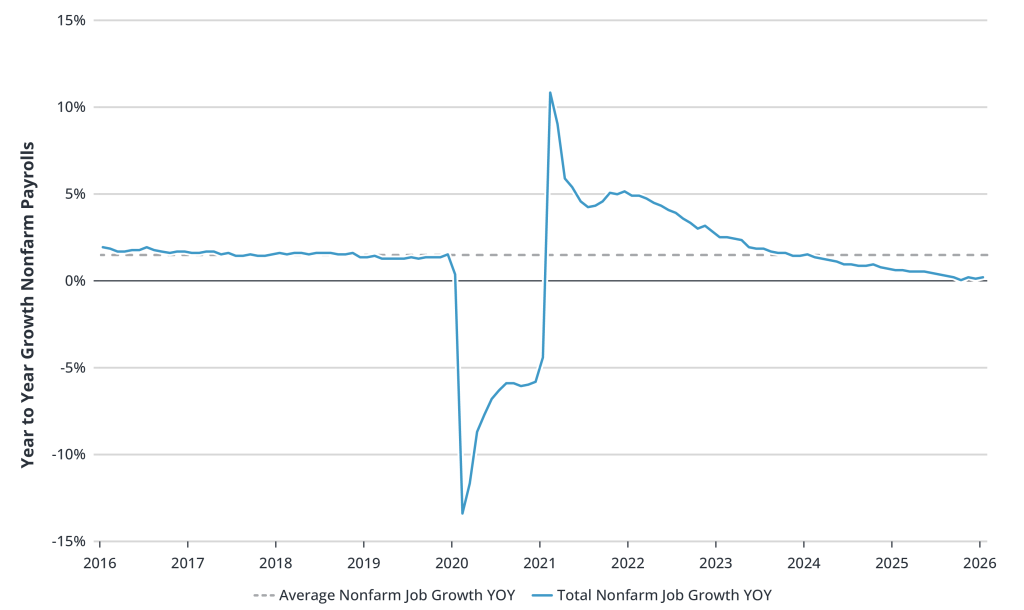
The March jobs report posted a substantial 178,000 jobs added during the month, up from -133,000 lost in February and well above the average of 9,700 jobs added monthly back in 2025. The unemployment rate even edged down from 4.4% to 4.3%. All in all, a welcome positive reading during a time of renewed uncertainty.
However, the job gains mostly affected the labor market’s most recent frontrunner—the health care and social assistance sector, which added 90,000 jobs (34% of which represent returning workers from the Kaisar Permanente strike in February). The construction sector also noted a noticeable increase last month, up 26,000 jobs, mainly due to warmer than average weather in March. While this is a stark turnaround from February’s report, because of these situational factors it’s an open question whether the growth in payrolls is due to upward fundamentals in the labor market or if it’s just a flash in the pan. Regardless, the staffing industry also saw gains in employment during March, including some upward revisions for previous months.
The elephant in the room is that the ongoing Iran conflict hasn’t shown up in the data yet. While this is a good thing for current stability, it also means the Federal Reserve will almost certainly hold interest rates steady. The Fed likely will prioritize controlling inflationary pressure from the related oil supply shock as well as the ongoing drag from tariffs. The future of the Iran conflict itself is still highly uncertain, with the possibility it could last weeks or far longer, including the risk it could escalate further to threaten passage through the Suez Canal, another vital shipping lane, via the Bab al-Mandab Strait.
While the war may not be showing up in the labor market now, it is possible that it could change on a dime as the concentrated nature of the job market means it is especially vulnerable to future volatility. While this would be largely negative for the industry, staffing companies should be proactively communicating with clients that they can better manage uncertainty via flexibility, leveraging temporary employees and employment solutions as valuable solutions to help them navigate an unpredictable environment.

The latest ASA quarterly survey results show that while the staffing industry continued facing headwinds and tight margins in 2025, there was some cause for optimism in Q4.
Quality data is vital to staffing companies looking to navigate uncertain economic times and make strategic decisions for the future. A valuable benchmarking resource is the quarterly ASA Staffing Employment & Sales Survey. ASA recently published fourth quarter and full year 2025 results (and survey participants received exclusive reports). Results show that while the industry continued facing headwinds and tight margins in 2025, there was some cause for optimism in the fourth quarter.
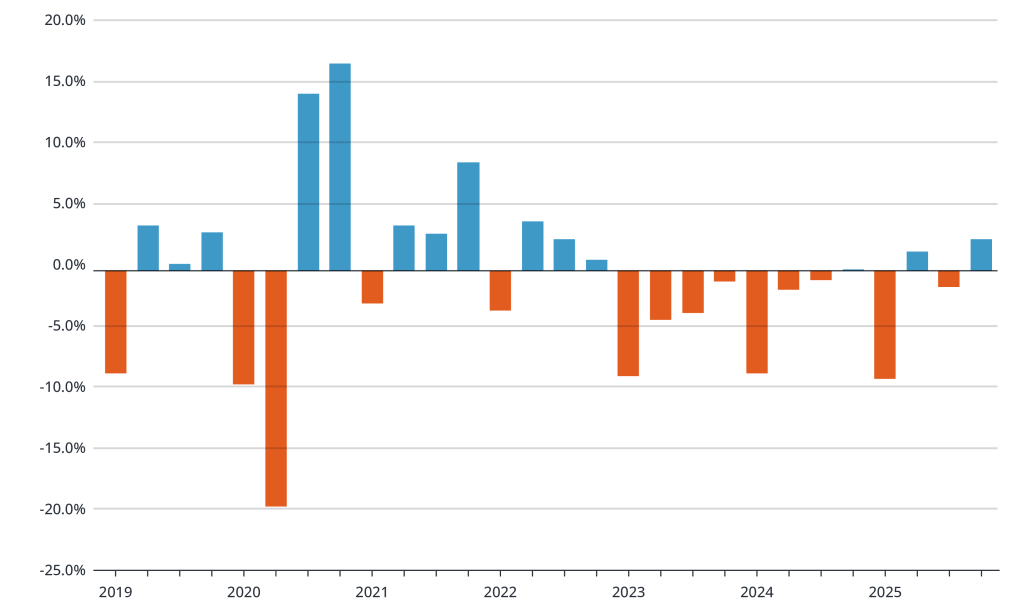
The industry continues to be beleaguered. With the total hiring rate within the job market easing to a level not seen since April 2020—and January 2011 before that—staffing firms continue to face muted demand as employers are cautious about hiring amid persistent economic uncertainty. The ASA quarterly survey found that full-year 2025 temporary and contract staffing sales were down 8.4% from 2024, marking the third consecutive year of contraction.
Margins are squeezed. Facing lower demand, heightened competition, and increasing costs, most staffing firms have had to trim their margins. Only 33% of firms grew their gross margin year-to-year in the fourth quarter of 2025, down from 36% in the third quarter. The fourth straight decline in as many quarters, this reading falls well below the long-run average of 51% since the metric was introduced in 2012.
Some positive signs are emerging. The quarterly survey found that while sales declined 6.2% year to year in the fourth quarter of 2025, it was also the smallest rate of decline since the first quarter of 2023. Further, staffing sales grew 2.6% from the third quarter, marking the largest sequential growth since the third quarter of 2022. While a retrenchment from 4Q2025 to the first quarter of 2026 is possible due to the seasonal pattern of the staffing industry, data from the weekly ASA Staffing Index suggests that growth in staffing employment has mostly persisted in early 2026 as well.
Looking to benchmark your company’s first-quarter performance? The 1Q2026 ASA Staffing Employment & Sales Survey is now open. Participation is free, and those who complete the survey receive an exclusive benchmark report along with access to an online archive of prior reports. Contact r*******@americanstaffing.net for more information or sign up on the survey page of the ASA website.