Staffing companies should expect uncertainty to linger and remain a primary challenge for the industry’s growth this year.
Max Aldrich

Staffing companies should expect uncertainty to linger and remain a primary challenge for the industry’s growth this year.
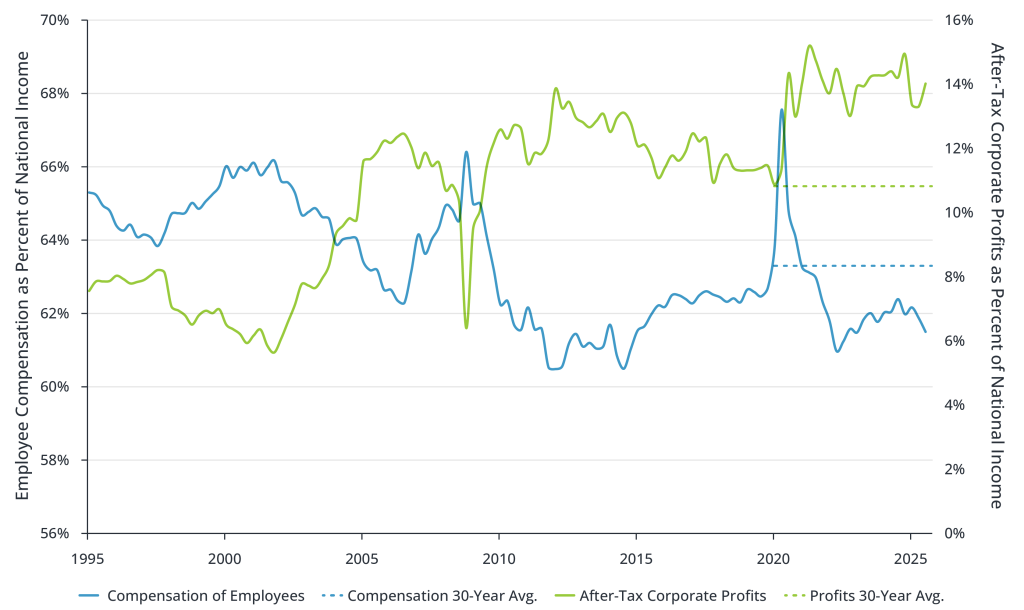
Squeezing profit margins has been a challenge in the business community, but while profits did indeed compress during 2025, they are also currently at historically high level. So how can it be that in the past profits were lower, but hiring was higher? According to the Bureau of Economic Analysis, after-tax corporate profits as a percentage of total national income did indeed fall by 1.6% in just two quarters—from 14.9% in 4Q2024 to 13.3% in 2Q2025. However, in 3Q2025, there was a rebound back to 14.0%, around 3.2% above the 30-year average of 10.8% since 1995.
If corporate profits can be considered a proxy for the private sector’s financial health, then why the glum outlook among employers? While corporate profits are historically high, stiffer competition and productivity expectations have raised the baseline as companies seek to make more from what they have in the face of rising costs. So, while the ability to take on workers may not necessarily be lacking, employers are still holding back because of economic uncertainty.
On the worker side, employee compensation as a percentage of total national income also has seen a downturn, having decreased by half a point from 62.0% in 4Q2024 to 61.5% in 3Q2025. But while corporate profits are above average, compensation is 1.8% below the 30-year average of 63.3%.
This coincides with a slowdown in wage growth as market conditions have eroded workers’ bargaining power and confidence within the job market. The nominal three-month average of median wage growth decreased from 4.2% in January 2025 to 3.7% in December according to the Atlanta Federal Reserve. When adjusting for inflation, real wage growth edged down as well, from 2.2% in 1Q2025 to 1.3% in 3Q2025, according to the Bureau of Labor Statistics. This implies that current market conditions are more of a challenge on the workers’ side than the employers’ side and helps illustrate the dearth of existing labor churn negatively impacting staffing companies as well.
If economic uncertainty is still the major barrier to labor market growth, then when might it recede? Clarity on trade policy would be welcome, but the Supreme Court is still deliberating on the legality of executive-imposed tariffs, prolonging the uncertainty. Lowering interest rates will also help, but stimulus from those take time to filter throughout the economy. Staffing companies should therefore expect that uncertainty is likely to linger and remain a primary challenge for the industry’s growth this year.

To entice candidates to vacancies, recruiters should be sure clients can clearly articulate the expectations of the open role and be prepared to speak to candidates about development opportunities.
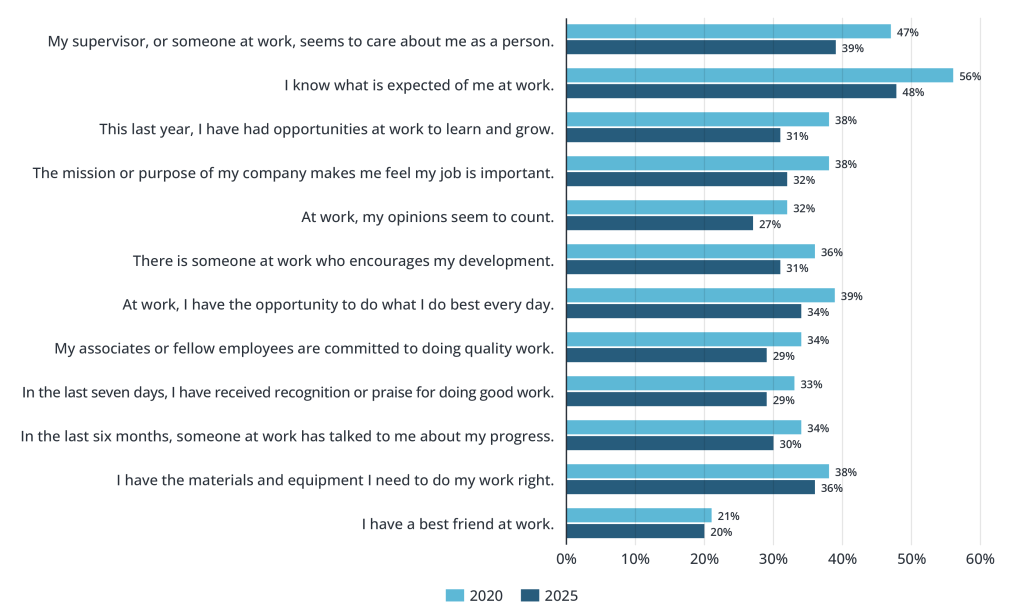
Employee engagement held steady from 2024 to 2025, but has declined since reaching a high in 2020, according to Gallup. In 2010, 28% of employees were actively engaged at work. That share grew steadily to peak at 36% in 2020. However, engagement then receded to 31% in 2024 and held there in 2025. This change equates to about eight million fewer engaged workers over that span.
What may have driven this five-year decline in worker sentiment? Of the 12 drivers Gallup uses to measure employee engagement, the ones that fell most were
This trend is even stronger among younger workers. While engagement among Baby Boomers has held steady, younger workers have seen the biggest decline in satisfaction since 2020. In addition to the factors listed above, the share of Gen Z and younger Millennials who report saying there’s someone at work who encourages their development fell. Older Millennials are also less likely to claim that someone at work has talked to them about their progress and that their opinions count at work than five years ago.
In today’s low-hire, low-fire environment, employee retention is up. But companies looking to keep that going when the labor market heats up should be working with younger employees to ensure they’re feeling good about their development and role in the company. To entice candidates to vacancies, recruiters should be sure clients can clearly articulate the expectations of the open role and be prepared to speak to candidates about development opportunities.