Since the Fed has elected to hold interest rates again, validated by a strong GDP print, the labor market is likely to remain frozen as borrowing costs continue to depress appetites for onboarding additional workers.
Noah Yosif

Since the Fed has elected to hold interest rates again, validated by a strong GDP print, the labor market is likely to remain frozen as borrowing costs continue to depress appetites for onboarding additional workers.
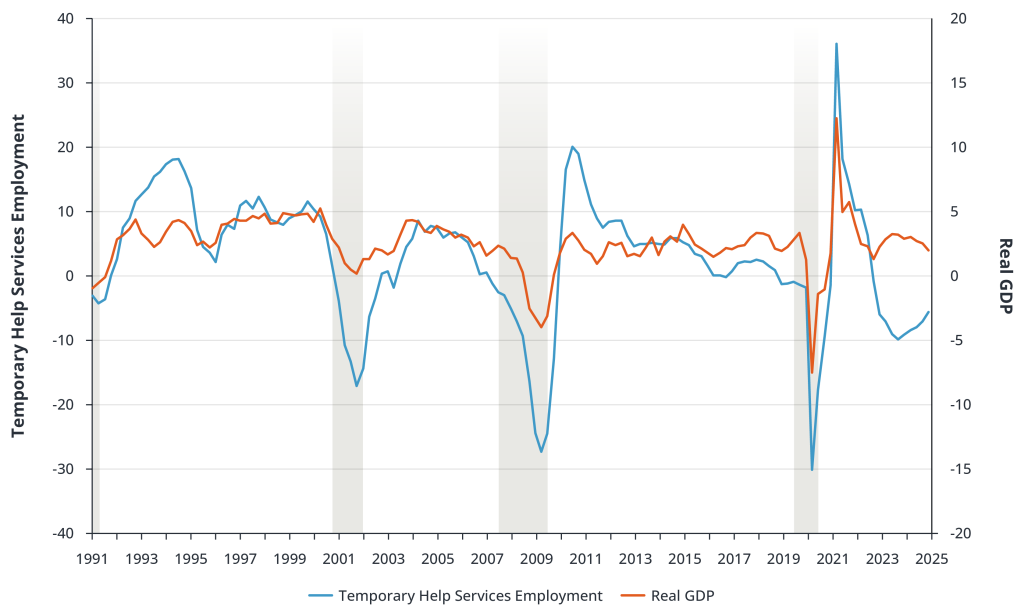
Over the past three years, the U.S. economy has demonstrated remarkable resilience, growing at a solid cadence despite record levels of inflation, elevated interest rates, and economic policy uncertainty. But for many in temporary help services, these achievements seem hard to believe. Over the same timeframe, the number of temporary employees has fallen to levels last seen coming out of the Great Recession, which has also driven a muted slowdown in industry sales. Conventional wisdom posits that temporary help services should benefit from the rising tide of a strong economy, so what explains this disconnect? Unfortunately, the temporary help services business thrives on sufficient labor market activity, and a strong economy does not always yield a strong labor market.
In the 1990s, growth within the labor market was driven by a 47% gain in gross domestic product (GDP). The remaining growth was driven by productivity growth, defined as improvements in output produced relative to inputs provided. Inputs are not only labor, but also capital, energy, materials, and services. In the 2010s, growth within the labor market fell to 23% of gains in GDP. In other words, the importance of labor market activity on overall growth has been mitigated by gains in productivity. This is precisely the scenario that has played out over the past three years: Increased labor costs driven by inflation and interest rates have forced employers to forgo hiring and make do with existing headcount—therefore increasing productivity.
This week the economy received two critical datapoints: an estimate of economic activity in the second quarter of 2025 and another decision on interest rates from the Federal Reserve. As real GDP exceeded projections of growth around 1.5%, then the disparity between economic activity and temporary help services employment will likely persist given employers’ focus on increasing productivity rather than their available labor. Furthermore, the Fed once again elected to hold interest rates, validated by strong GDP, and the labor market could remain frozen as borrowing costs continue to depress appetites for onboarding more workers. These dynamics would likely elongate the current gap between staffing employment and growth within the overall U.S. economy.

The declines within the industrial sector have contributed greatly to declines in overall staffing employment as the majority of temporary workers are employed within this sector.
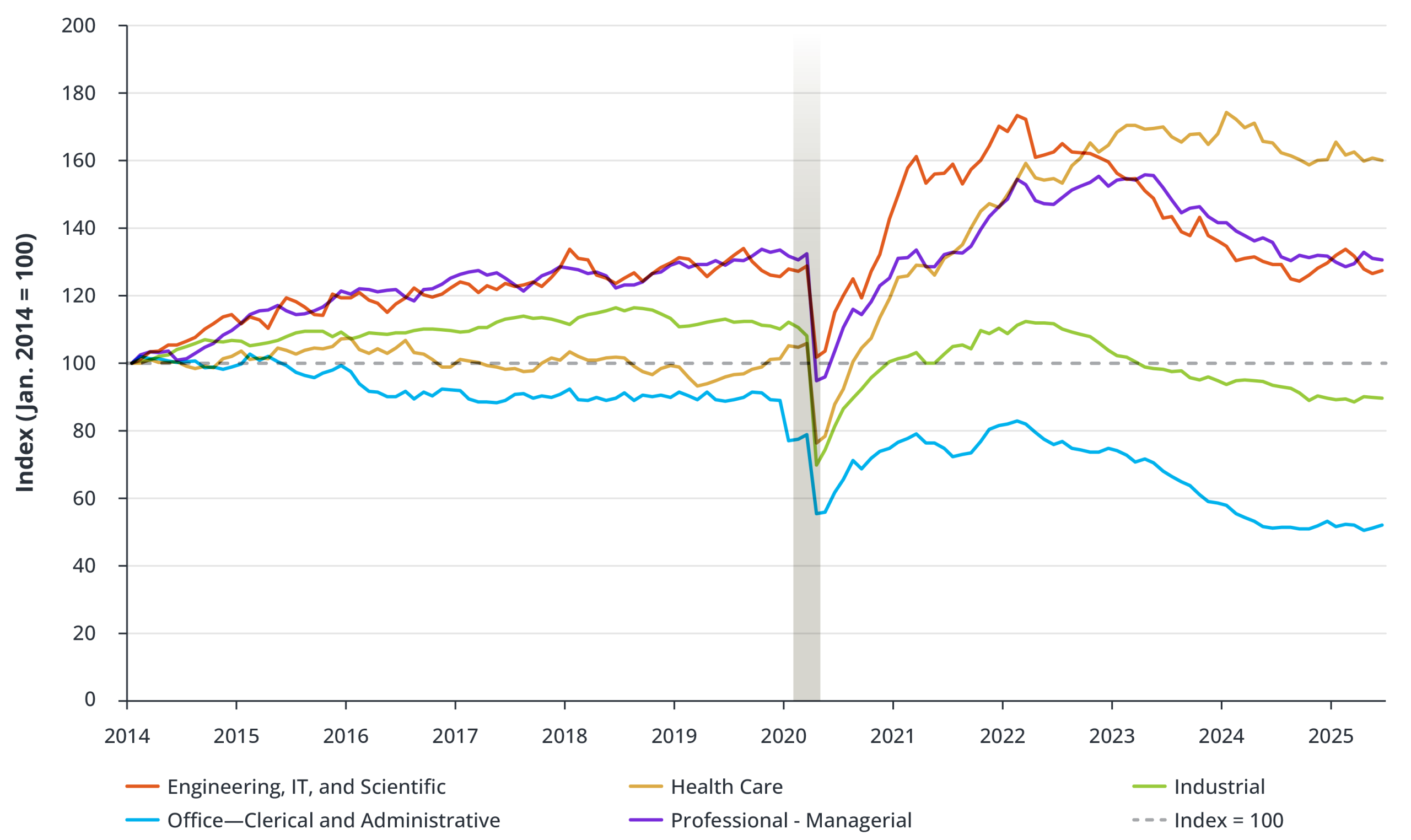
According to ASA analysis of data from the U.S. Bureau of Labor Statistics, since the Great Resignation, staffing employment has been on the retreat in every sector with the relative exception of the health care sector, while the industrial and office–clerical sectors now employ fewer temporary workers than in 2014. Staffing employment within the professional–managerial and engineering, IT, and scientific sectors has contracted, but current levels are around where they were prepandemic and do not appear to be contracting further.
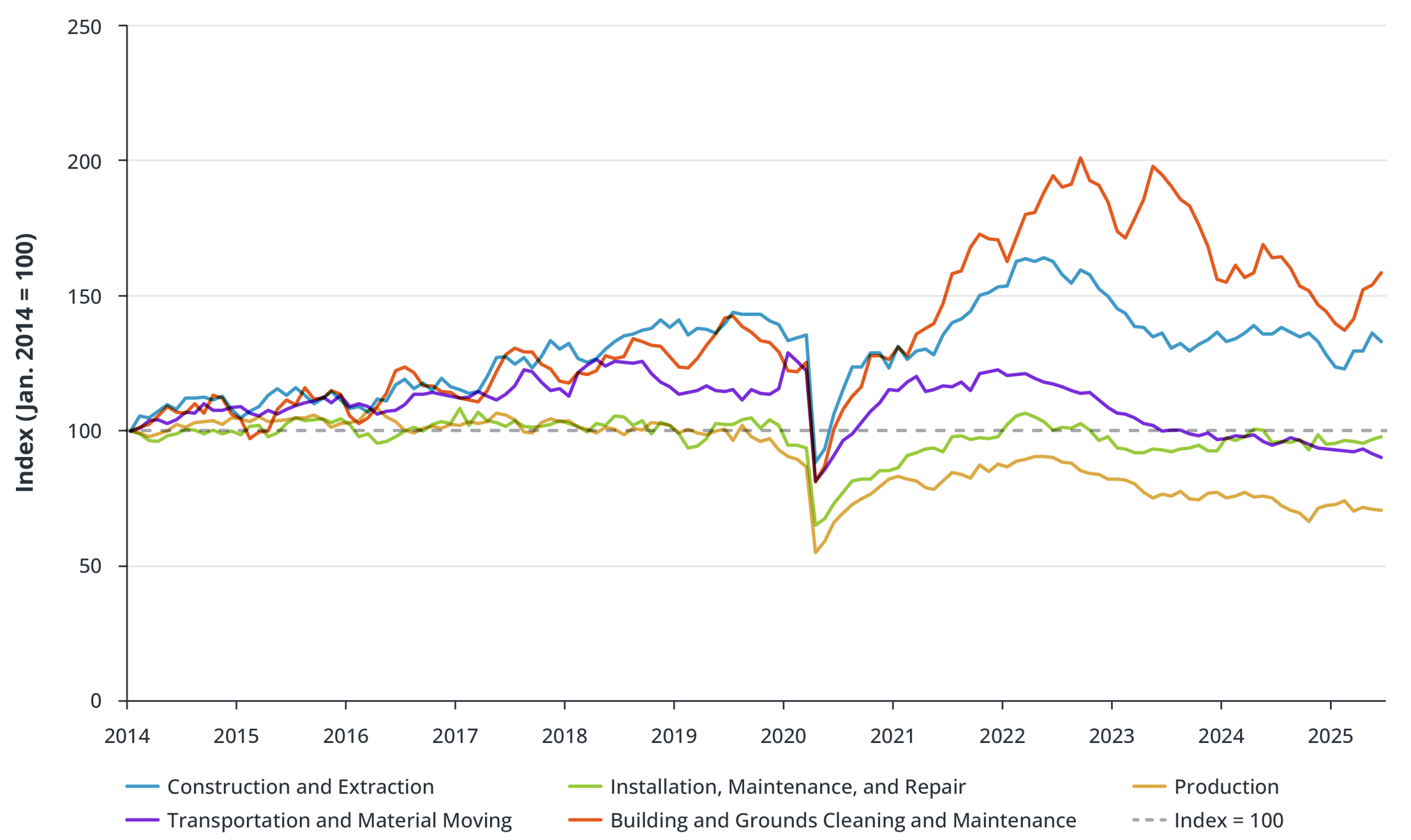
Declines within the industrial sector have contributed greatly to declines in overall staffing employment as the majority (54.5%) of temporary workers are employed within this sector. Indexing the levels of staffing employment from all five major staffing sectors since January 2014, industrial staffing employment since the start of the Covid-19 pandemic peaked at a rounded value of 112 in March 2022—this is equivalent to the value recorded right before the pandemic—and it was down to a value of 90 as of June 2025. This means that in total, industrial staffing jobs have contracted by around 22% compared with the prepandemic baseline.
The two largest occupation groups within the light industrial vertical (as measured by total temporary workers employed), production occupations, along with transportation and material moving occupations, are now below recorded levels prepandemic. Increased automation within this sector, along with elevated inflation and interest rates, have caused industrial staffing employment to fall below prepandemic levels. As current demand for temporary help services is concentrated in verticals that make up a smaller portion of industry employment (for example, health care represents 10.2% of total staffing jobs and professional–managerial 17.3%) a robust recovery in staffing employment will depend heavily on improved labor market churn, ideally triggering broader growth across all sectors.
 Source: US Bureau of Labor Statistics, US Census Bureau, ASA Research Department
 Source: US Bureau of Labor Statistics, US Census Bureau, ASA Research Department
 Update for Jul 30, 2025
