Last week, Fed Chair Jerome Powell characterized the U.S. labor market as ‘solid,’ ‘healthy,’ and ‘broadly in balance,’ which is Fed speak for currently experiencing acceptable losses, as the Fed stays focused on inflation.
Noah Yosif

Last week, Fed Chair Jerome Powell characterized the U.S. labor market as ‘solid,’ ‘healthy,’ and ‘broadly in balance,’ which is Fed speak for currently experiencing acceptable losses, as the Fed stays focused on inflation.
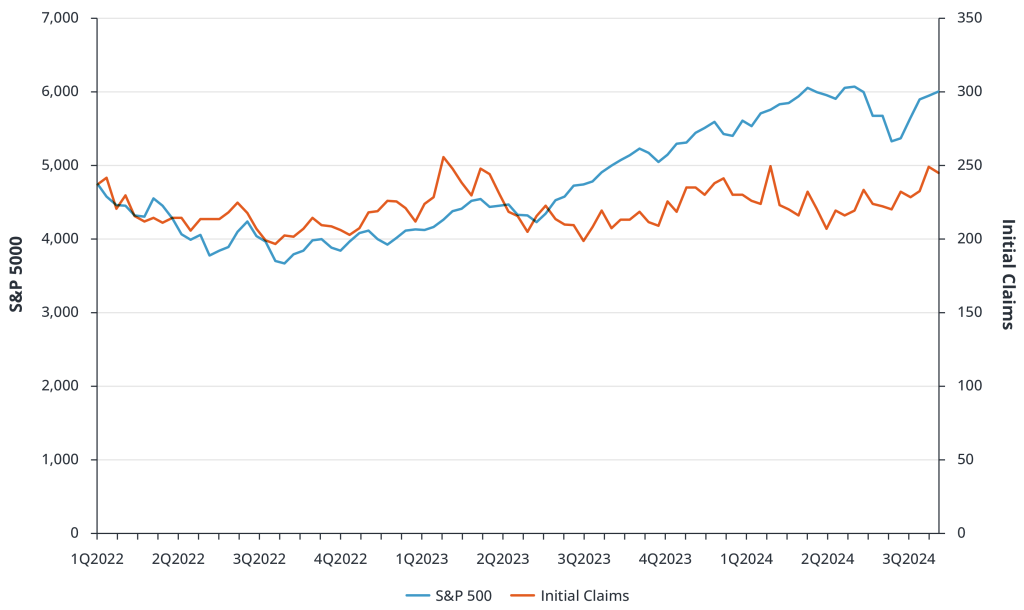
Most experts agree that labor market activity remains frozen due to elevated borrowing costs, but what happens if borrowing costs stay elevated in the long term? Because that is a likely reality. Last week, Federal Reserve Chair Jerome Powell characterized the labor market as “solid,” “healthy,” and “broadly in balance,” which is Fed speak for currently experiencing acceptable losses, as the Fed remains focused on controlling inflation. ASA data analysis shows that an extended rise in labor costs could lead to a prolonged shift away from investments in labor and instead lead to capital investments, as employers remain fixed on ways to maintain their bottom lines while using fewer employees.
This is best illustrated by plotting gains within the S&P 500 against initial unemployment claims. Over the last three years, both have grown in tandem, which suggests that companies are indeed doing well financially as the labor market realizes some attrition. If these trends continue, there is a real risk that many lost jobs as a result of higher borrowing costs will be allowed to remain unfilled even as economic conditions normalize. This would mean an elongated return to normalcy for the labor market even as conditions within the broader economy are healthy and typical of another expansionary cycle.
To avoid an elongated, and perhaps costly, return to full employment, those on the sidelines will have to focus on pivoting and gaining new skills now, while conditions remain turbulent, to prepare for a future where employers are encouraged to increase headcount again. Staffing firms can assist in this transition by working with their candidates on expanding and improving their skills and credentials to better serve clients seeking to hire again.

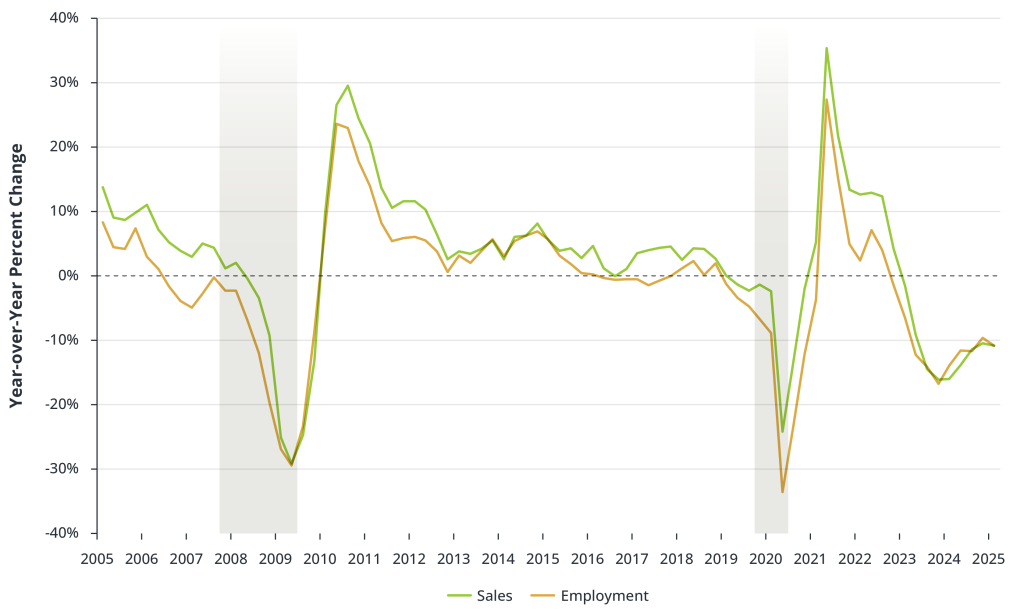
While this is an improvement of around three points, it also shows the industry is taking much longer to recover employment levels compared to the aftermath of the 2008 or Covid-19 recessions.
Data released last week from the quarterly ASA Staffing Employment and Sales Survey showed that the industry continues to make incremental gains since entering a downturn following the Great Resignation. While the industry contracted to employ just under 2.0 million temporary and contract workers per week in the first quarter of 2025, a staffing employment and sales decline from the fourth to first quarter is a well-known seasonal pattern. Employment decreased 9% quarter to quarter, in line with the historical average decline of 8.2% every year since 2008, suggesting that the industry is not facing any atypical erosion. Staffing sales followed a similar pattern, decreasing by 8.8%, compared to the historical average of 6.6% for the same period.
More encouragingly, the year-to-year gap in staffing employment continues to make a steady, if lengthy, recovery. Staffing employment was down 10.8% year to year in the first quarter of 2025, compared to 13.8% in the first quarter the year prior. While this is an improvement of around three points, it also shows the industry is taking more time to rebuild employment levels compared to the aftermath of the 2008 or Covid-19 recessions. Despite the broader economy avoiding a formal recession in the postpandemic era, the staffing industry remains burdened by persistent headwinds that stunt its recovery. With economic uncertainty compounding these difficulties, it is likely this lengthy recovery might stretch out a little longer as employers continue to keep hiring on hold until outlooks improve.
 Update for Jun 25, 2025
