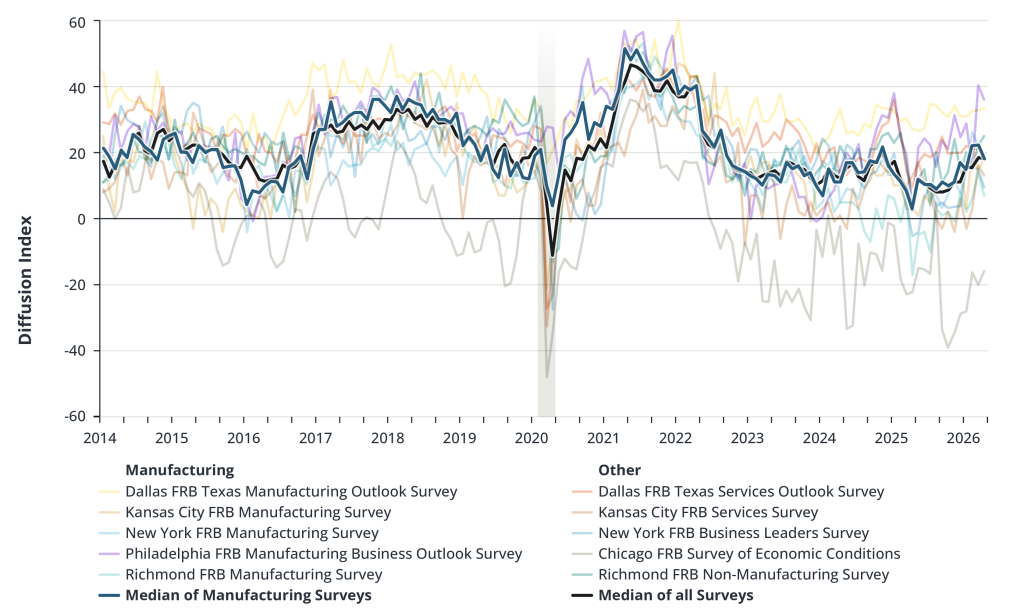
When aggregated, median trends suggest that intentions to hire have improved since reaching record lows in early 2025. While still trailing levels prior to the Covid-19 pandemic (when labor market momentum was stable and trending at healthy levels), most surveys are tracking an increase in future hiring.
Weekly Economic Outlook
05/29/2026
Great Expectations? The Course for Hiring in 2026
Sometimes, the best way to predict the future of hiring is to simply ask employers whether they intend to add headcount. That is the beauty of many business surveys that are conducted by regional Federal Reserve Banks across the country. When aggregated, median trends suggest that intentions to hire have improved since reaching record lows in early 2025. While still trailing levels prior to the Covid-19 pandemic (when labor market momentum was stable and trending at healthy levels), most surveys are tracking an increase in future hiring.
The results are somewhat more optimistic for the staffing industry: 51% of the temporary workforce are employed in the industrial/manufacturing sector, transportation/warehousing sector, and other goods-producing sectors. Employers in these particular segments of the labor market seem to be even more optimistic about their future hiring needs, suggesting that the staffing industry could reap some of the gains from increased labor churn.
However, a more realistic course for hiring in the near future could be somewhat less optimistic. Many employers are still adjusting to higher levels of inflation induced by U.S. operations in Iran, which have resulted in fewer oil supplies. If this conflict continues to drag on, expectations for hiring could reach a peak or decline.
For staffing companies, these results affirm that employers want to expand their payrolls despite an increasingly uncertain economic landscape. This could allow for the industry to begin clawing back some of the market share which it lost throughout much of the last two years.
Diffusion Indexes of Hiring Expectations
Weekly Staffing Research Outlook
05/29/2026
As clients increasingly value risk management, employed job seekers can be seen as a less risky commitment compared to someone who is trying to reenter the job market.
Employed Job Seekers Have the Advantage
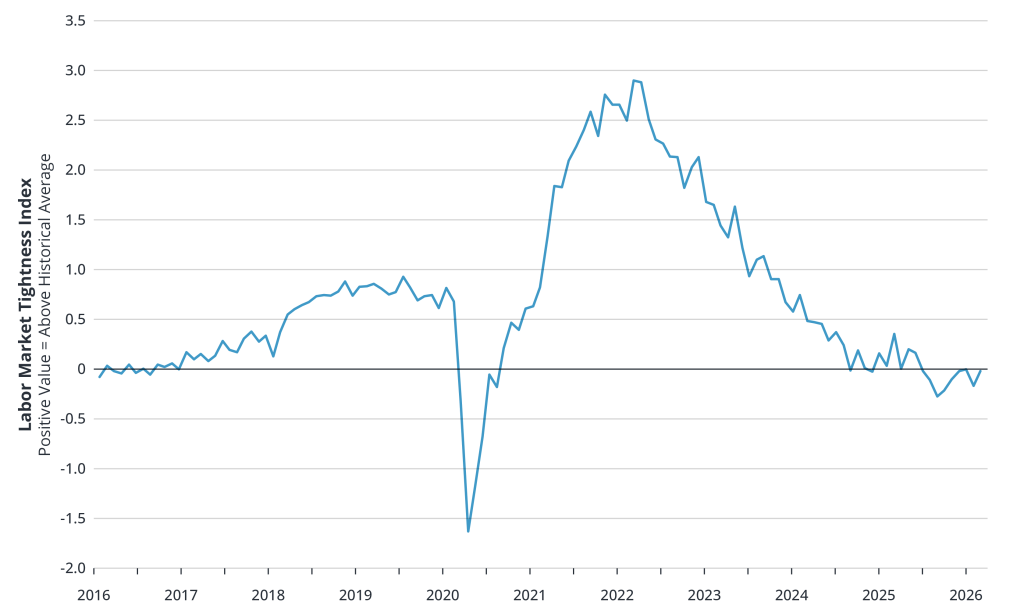
The labor market certainly is loose by comparison to previous years, but nonetheless, it is also about as tight compared to its historical average since 1994, according to the HPW Labor Market Tightness Index from the New York Federal Reserve. This means that, in the short term, there will be steady upward pressure on wage inflation even amid record-low hiring activity among employers and a gradually growing body of unemployed. While the latter two should generally point toward lower worker leverage and therefore lower wage growth, a major reason for the persistent growth in employment costs can be found among the fortunate ones in the labor market right now—employed job seekers.
Unlike other measures of labor market tightness, the HPW Index considers the behavior of workers who may be searching for new employment while on the job. Employed job seekers have a distinct advantage over their unemployed counterparts; they have already proven that they’re employable to prospective employers. As clients increasingly value risk management, employed job seekers can be seen as a less risky commitment compared to someone who is trying to re-enter the job market.
Staffing firms should be conscious that client standards are especially high in the face of economic uncertainty and that sourcing a candidate who is already employed can take some hurdles out of the way, even if it has not been outright stated as their preference. However, staffing firms should definitely advocate for qualified candidates who may also be jobless. Helping clients understand that they may be overlooking a quality worker will help both the client and the candidate. Working inside a tough hiring environment means staffing firms can lean on communication and trust-building to demonstrate value as the staffing industry helps match talent to where it is needed most.
Labor Market Tightness Index