SPONSORED CONTENT
 Through satisfaction surveys and service-quality benchmarking, ClearlyRated helps staffing firms measure the experiences of their clients, candidates, and internal employees to reduce attrition, differentiate on service quality, and build online reputation. Visit clearlyrated.com to learn more.
“If only we had known…”
Even staffing leaders who regularly survey their clients have likely uttered those five devastating words on occasion. Maybe it happened at a quarterly business meeting when you discovered complaints about your company’s communication cadence in the open-ended comments from a survey…after the client severed ties with you.
Or perhaps one of your exiting top performers confided in you that they might have stayed if someone had talked to them about their career development.
Or suppose you learned that your net promoter score (NPS) of 55—a number you always took pride in—is not quite as high as the last rating from your closest competitor. How would that information change your approach to managing the client?
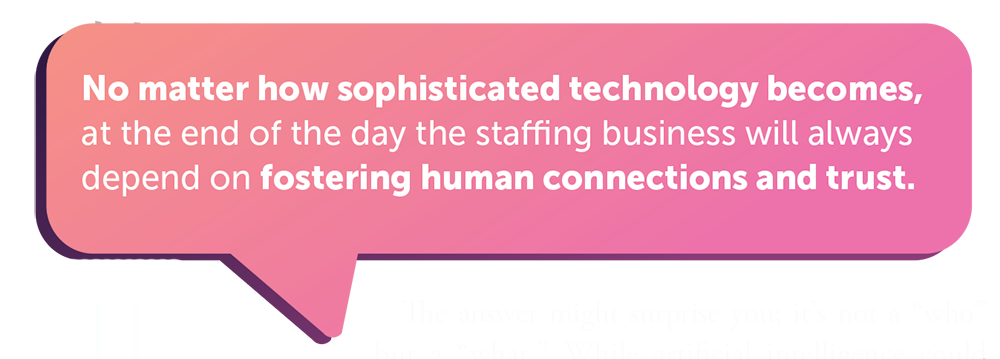
All of these scenarios illustrate the power of reaching out to the right client at the right time. They also underscore that, no matter how sophisticated technology becomes, at the end of the day the staffing business will always depend on fostering human connections and trust.
“In a people business, the relationship is the product,” says Baker Nanduru, chief executive officer of ClearlyRated, a leading customer experience (CX) platform designed specifically for B2B service firms. But who has the time to do the kind of exhaustive analysis needed to translate nuanced client feedback into specific, human-centered solutions that can enhance CX and bolster your bottom line?
The answer might surprise you; it’s not a “who” but a “what.” While artificial intelligence could never substitute for the personal touch on which the staffing industry relies, today’s AI capabilities can provide staffing professionals with the precise information they need to reach out to their clients when it matters most.
“The firms navigating AI most successfully are using it to amplify human capability—not replace it,” says Nanduru. “The technology is going to bridge the gap between feedback and business outcomes.”
It’s no wonder ASA and Staffing Industry Analysts both named AI among their top staffing trends of 2026, with ASA noting that staffing firms are using the technology to source candidates, streamline interviewing, drive sales, and more.
A Changing Landscape
Increasingly, AI is table stakes for a successful CX strategy. A recent survey by Gartner estimated that 85% of customer service leaders would explore or pilot a customer-facing conversational generative AI solution in 2025. Additionally, three-quarters of consumers now expect instant answers to their queries, according to the CX magazine Call Centre Helper.
That growing need for speed also helps explain why the organizations that integrate AI into their business operations are now reporting a 1.7x higher return on investment (ROI), according to a report from Capgemini Research Institute. And confidence in AI’s commercial viability is only growing, with 40% of organizations expecting positive ROI within one to three years and another 35% within three to five years.
When it comes to the staffing industry in particular, clients’ expectations have never been higher. The industry’s overall client net promoter score—a key indicator of customer loyalty and satisfaction—hit an all-time high in 2024, up from -2 in 2019. (See sidebar, “NPS and ROI: What’s the Connection?”)
Moreover, the biggest-ever single-year jump in NPS—of 9 points—took place between 2023 and 2024, pointing to how quickly AI-based solutions have translated into meaningful differences in CX.
“Clients now know what great service feels like from the top performers in the industry,” says Nanduru. “They expect more, and the firms coasting on adequate service are increasingly measured against a higher standard.”
These trends translate to your talent, as well. In 2024, the candidate experience NPS of 30 was the highest it had been since 2013. Clearly, today’s workforce has high expectations—and, in a tight labor market, job seekers have plenty of employment options for meeting them.
For firms that want to prove their value by benchmarking their performance, independent certification is increasingly the differentiator. ClearlyRated’s Best of Staffing program—which fewer than 2% of North American staffing firms qualify for—gives agencies a third-party verified NPS. That holds considerably more credibility with clients than self-reported claims.
In fact, the clients of award winners are 50% more likely to report complete satisfaction—and placed candidates report 60% higher satisfaction—compared to the industry averages. In a market where every firm promises to be a “true partner,” this could make the difference between claiming service excellence and proving it.
Be aware of bias. AI’s outputs will reflect any biases that may be lurking in your input data. These biases aren’t always obvious—which means that, in addition to feeling confident about the robustness of your dataset on the front end, you must regularly audit outputs on the back end. For example, is your churn prediction model flagging segments of workers based on actual behavior, or is it tying churn to factors that defy explanation and/or could be a result of bias?
“Our data goes through a whole bunch of layers of isolation, scrutiny, and guardrails,” says Nanduru. “Any other data we use are typically trusted sources from our clients,” he adds, pointing to information gleaned from customer feedback, applicant tracking systems, enterprise resource planning software, and other systems.
Take accountability for decisions. While AI serves as a flag that something needs attention (whether it’s a client concern or a troubling staffing metric), only the client or relationship manager can make the call about what to do about it—in other words, a human. “AI does the pattern recognition. Humans do the meaning making,” Nanduru points out. That approach is core to ClearlyRated’s philosophy.
Close the feedback loop. By the same token, AI’s fast analysis only translates into fast solutions if you have well-defined processes in place about who will follow up, when, and how. Think that through now so you can act decisively when the time comes.
Having a human close the loop matters a lot to customers too, with 90% favoring human interaction over chatbots, according to research from global learning platform Complete AI Training. Again, it all comes back to trust.
“Trust is the last sustainable moat in a commoditizing industry,” Nanduru says. “And trust is built on one honest conversation, one resolved complaint, one memorable moment of service at a time.”