For staffing firms—like all employers—implementing comprehensive antidiscrimination and antiharassment trainings is essential to fostering an equitable, productive, and legally compliant workplace. However, a recent federal court decision highlights why such trainings should never single out members of any particular race or other group—and especially not in a negative or stereotypical way.
When Training Crosses the Line
In September, a federal appeals court in New York reviewed a case (Chislett v. New York City Department of Education) brought by a white employee who claimed she experienced a hostile work environment because of mandatory implicit bias trainings that included repeated references to terms like “white privilege” and “white supremacy.” The court reviewed the record supporting the employee’s claim in detail and determined there was enough evidence for the case to proceed to a jury trial.
The employee was required to attend numerous implicit bias trainings facilitated by her employer and outside vendors that the court found amounted to “racial harassment.” To name a few examples, the trainings described traits of “internalized white superiority,” characterized “white culture’s values” as “homogenous and supremacist,” and instructed participants to rate themselves “according to their [white] privilege.” Content from the trainings “spilled over” into the work environment, for example, when a colleague told the employee she was “socialized as a white person to be defensive.” Neither the employer nor the employee’s supervisors did anything to address the employee’s complaints about the trainings or the hostile treatment she faced.

Importantly, the court rejected the employer’s argument that these statements could not create a hostile environment because they occurred during discussions about combating discrimination. At the same time, the court was at pains to point out “we do not suggest that the conduct of implicit bias trainings is per se racist,” but what mattered was the way the trainings were conducted. The court explained that when trainings discuss race “with a constant drumbeat of essentialist, deterministic, and negative language about a particular race, they risk liability under federal law.” Finally, the court found the hostile environment could be imputed to the employer because it knew the employee had complained about “racialized harassment” but failed to intervene.
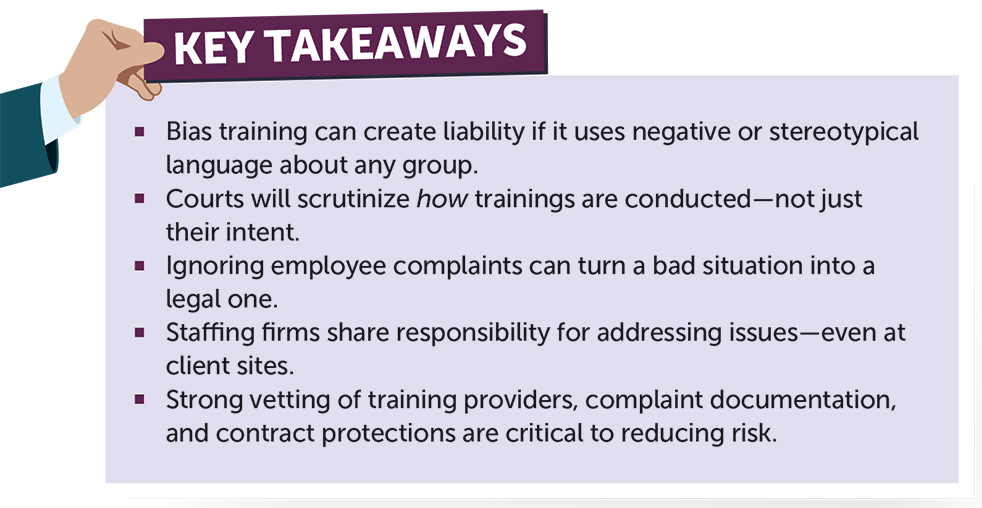
To avoid potential liability, staffing firms should consider trainings for their employees that acknowledge people of all races and backgrounds carry implicit biases based on their own individualized experiences. Firms would be well-served by rigorously vetting any third-party trainers and conducting a legal review of trainings prepared or given by internal employees.
Employer Responsibility Beyond the Classroom
Of course, staffing firms may not be able to control what their temporary employees experience while at a client’s workplace.When an employee makes a complaint about alleged unlawful harassment or discrimination—regardless of whether the incident occurred while working directly for the staffing firm or for a client—the firm should respond promptly. If the incident occurred at a client’s workplace, the staffing firm should promptly report the alleged misconduct to the client. The staffing firm has an independent duty to evaluate and investigate the complaint, but a staffing services agreement may require the firm’s client to cooperate and assist in the investigation and resolution of any employee complaints. A staffing services agreement may also require clients to affirm that they are equal opportunity employers and in compliance with federal, state, and local law.
Importantly, staffing firms should thoroughly document all steps taken in response to employee complaints. In the federal case discussed above, the statements made by presenters during implicit bias trainings were problematic, but the employer potentially could have avoided liability if it had a documented history of taking the employee’s complaints seriously and responding with appropriate action.
Finally, a staffing services agreement may include provisions requiring a client to indemnify the staffing firm from damages, costs, and attorneys’ fees arising from any violation of antidiscrimination and antiharassment laws. Although not every incident will result in an external complaint or lawsuit, it is important for staffing firms to understand their financial risk and exposure—including from conduct committed by a client.
By implementing unbiased and wellvetted training programs, responding diligently to all employee complaints, and carefully reviewing the terms of all staffing services agreements, staffing firms can minimize the risk that they will face liability or damages arising from employee discrimination and harassment complaints.
This material is not intended, and should not be relied on, as legal advice. ASA members should consult with their own counsel about the legal matters presented.

is counsel in Tannenbaum Helpern’s Employment Law practice. He represents clients in federal and state courts in connection with claims of discrimination, retaliation, and hostile work environment. He is an accomplished litigator with experience managing all stages of employment litigation., and previously spent over a decade at the New York City Law Department—the largest municipal law office in the U.S. Send feedback on this article to c****@thsh.com.